Equipment
Commutators
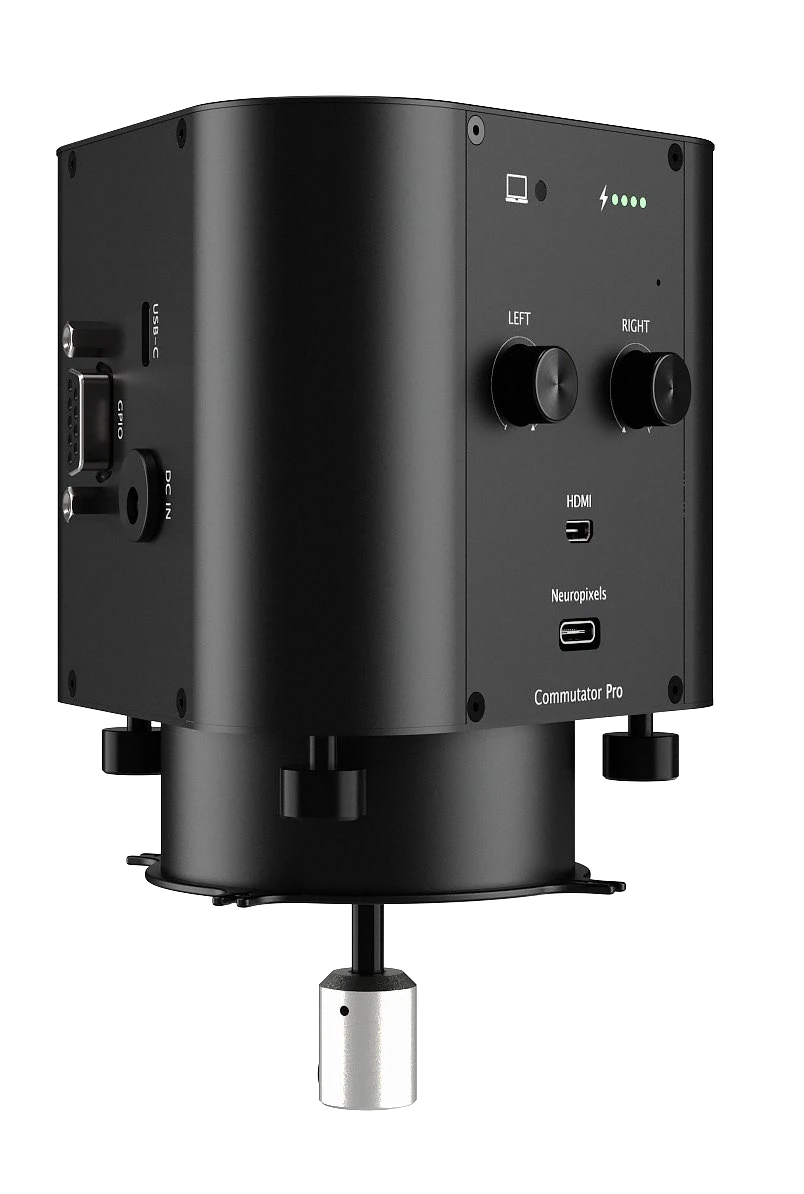
Two commutators for freely moving recording: the passive Standard Commutator and the motorized Commutator PRO. Both carry an X-Series headstage to XDAQ; the PRO also carries up to four Neuropixels probes.
Why the Commutator PRO
No pull reaches the animal. A gyroscope on the head senses the animal's turn, and the motor moves the joint before the cable twists.
Built for mice. A passive joint needs the animal's own mass to turn it; the PRO removes that lower limit on animal size.
Neuropixels and a passive probe on one joint. Up to four Neuropixels ports, and on the Dual Mode an X-Series headstage beside them: record Neuropixels and stimulate through a passive probe at once.
Head orientation, logged. The gyroscope's orientation and the motor position stream over USB every 20 ms (firmware 1.2), beside the recording.
A fluid line or an optical fiber through the joint, with the optional 5 mm passthrough; a 6-hour battery for a rig with no wall power.
Or the Standard: passive, no electronics in the signal path, no power, 42 × 42 × 87 mm, for a rat on a passive probe in a crowded rack.
Commutators
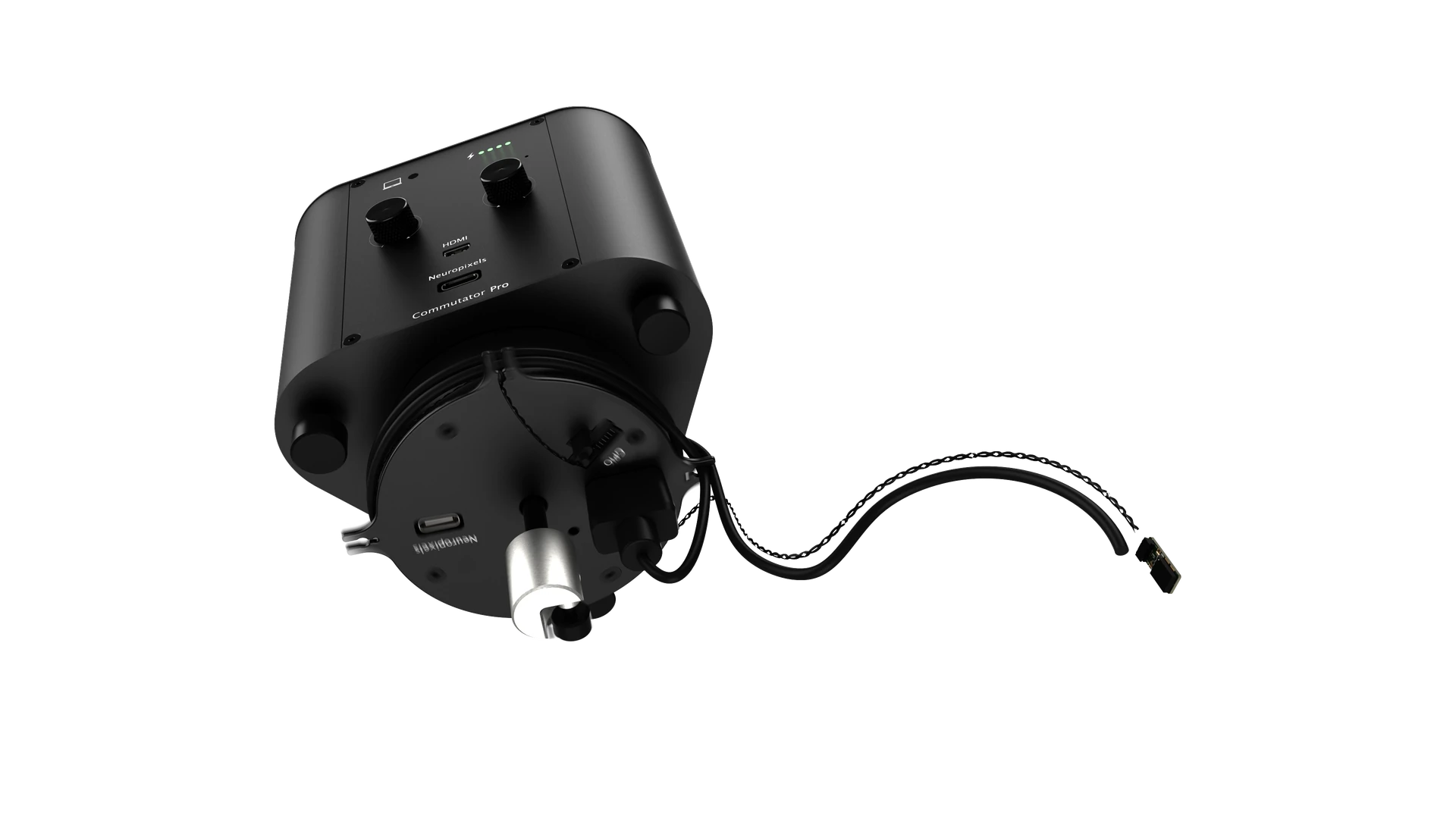
Two commutators for freely moving recording, both engineered and manufactured by Kontex and commercialized by NeuroNexus. The Standard Commutator is passive and mechanical: no motor and no power, 256 channels per cable from an XR record headstage and 32 from an XSR stim-record headstage, in a 42 × 42 × 87 mm body. The Commutator PRO is motorized, with active torque compensation sensed by a gyro on the animal or a Hall encoder on the rotor; it carries 256 XR or 64 XSR channels per cable and up to four Neuropixels probes. A commutator is optional: a head-fixed or short-session preparation connects the headstage to the DAQ directly.
Commutator PRO
Motorized commutator · Neuropixels, HDMI or Dual Mode · IMU or Hall sensing
- Models
- Neuropixels, HDMI, or Dual Mode Commutator PRO
- Torque Sensing
- Gyroscope on the animal (I/IH), follows its turn; or Hall sensor on the rotor (M), reads the twist
- IMU Data Out
- Orientation and motor position over USB, JSON, every 20 ms (firmware 1.2; gyro configurations)
- Neuropixels Ports
- 1, 2 or 4; up to 2 with an HDMI port (Dual Mode)
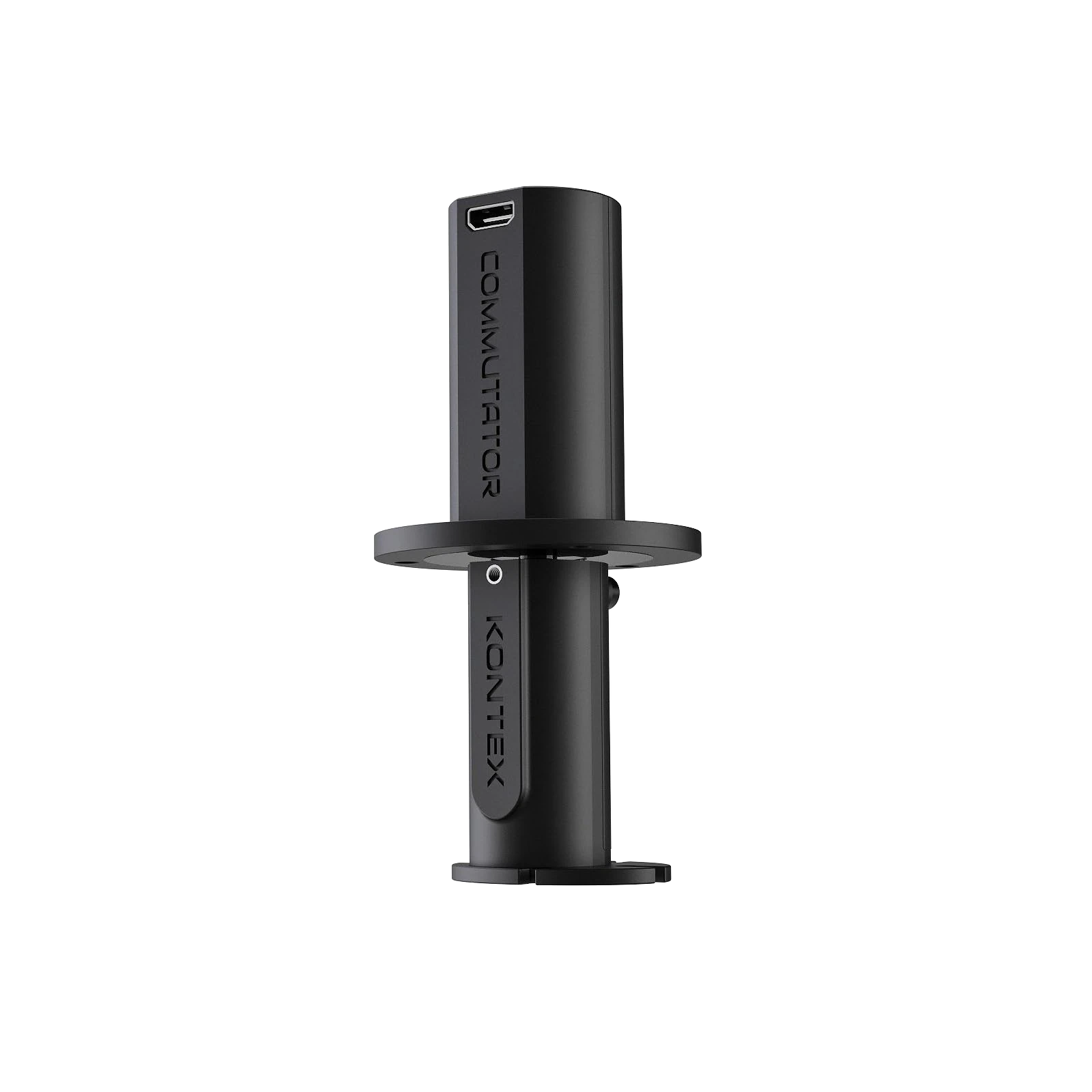
Standard Commutator
Non-motorized commutator · XR 256ch / XSR 32ch · plug-n-play
- XR Headstages
- Recording, up to 256 ch/cable
- XSR Headstages
- Stim-record, up to 32 ch/cable
- Power
- None — no external power
- Mounting
- 3.2 mm mounting hole
Which commutator?
The Standard where the animal's own motion may turn the joint; the PRO where no torque may reach the animal, or where Neuropixels ports, GPIO, a passthrough or a battery are needed.
| Standard Commutator | Commutator PRO | |
|---|---|---|
| Models | One: the Standard Commutator (HDMI) | Three: Neuropixels, HDMI and Dual Mode Commutator PRO |
| Actuation | Passive, mechanical: the tether turns the joint | Motorized: a motor and microprocessor cancel the cable torque |
| Torque sensing | None: the animal turns the joint | Gyroscope on the animal (34 AWG cable, under 1 g), following its turn; or Hall sensor on the rotor, reading the twist |
| Headstage channels, recording (XR) | 256 per cable | One HDMI port: up to 128 (XH1) or 64 (XH2) |
| Headstage channels, stimulate and record (XSR) | 32 per cable | 32 (XH1) or 16 (XH2) |
| Neuropixels ports | None | 1, 2 or 4, each taking one Neuropixels 1.0 or two 2.0 probes; up to 2 beside the HDMI port on the Dual Mode |
| General-purpose I/O | None | Up to 9, by model |
| Passthrough | None | Optional 5 mm channel for a fluid line or an optical fiber |
| Power | None required | Plug-in, or an optional 6-hour battery |
| Size | 42 × 42 × 87 mm | 99 × 105 × 150 mm |
| Weight | See datasheet | About 825 g |
| Mounting | 3.2 mm mounting hole | Bottom thumb-screw or ¼-inch camera mount |
| Cable management | Integrated animal-side cable storage; off-center tether | Integrated; PC- and panel-controlled rotation override |
| IMU data out | — | Orientation and motor position over USB, JSON, every 20 ms (gyro configurations, firmware 1.2) |
Both are engineered and manufactured by Kontex and commercialized by NeuroNexus. The full selection logic, with the preparations each suits, is in the guide.
Do you need one?
A commutator is optional. A head-fixed preparation, or a short acute session, connects the headstage to the acquisition system directly. A freely moving chronic preparation needs the rotating joint: without it the tether winds up as the animal turns, pulls on the implant, and ends the session early.
Where it sits in the chain
Headstage, then commutator, then acquisition system. Every X-Series headstage and every XDAQ that connects to each commutator is a published row in the Connection Finder; open it with the commutator pinned and the rest of the chain fills in.
Used with
The cables, the Kontex NP headstage, the system adapter and the freely-moving packages that complete the rig.
Documents and terms
Research use only. NeuroNexus products are for non-clinical research use and must not be used in human or veterinary medical procedures.
Commutators — FAQ
Do I need a commutator?
Only for a freely moving animal on a tether. A head-fixed preparation and a short acute session connect the headstage to XDAQ directly. In a freely moving chronic preparation the tether turns with the animal, and without a rotating joint the twist accumulates in the cable: the animal feels the pull, the head connector takes the load, and the recording picks up the movement.
How many channels can a commutator carry?
It depends on the model. The Standard Commutator passes up to 256 channels per cable from a record (XR) headstage and up to 32 from a record-and-stimulate (XSR) headstage. The Commutator PRO's HDMI port carries up to 128 XR or 32 XSR channels (the XH1 configuration), or 64 and 16 in the XH2 configuration, and its Neuropixels ports each take one Neuropixels 1.0 probe or two Neuropixels 2.0 probes, on up to four ports. The PRO also adds up to nine GPIO lines, by model. The headstage decides the rest: a 32-channel headstage uses 32 of them.
Can I use a commutator with Neuropixels?
Yes. The Commutator PRO has up to four Neuropixels ports, each taking one Neuropixels 1.0 probe or two Neuropixels 2.0 probes. A gyroscope on the animal follows its turn before the cable twists, or a Hall sensor on the rotor reads the twist, and a motor cancels the torque, so a freely moving animal supplies no force. The Dual Mode model carries a passive probe on its HDMI port at the same time.
Which commutator: Standard or PRO?
The Standard is passive: the animal's own rotation, through an off-center tether, turns the joint, with no power and no sensor; it suits a rat on a passive probe. The Commutator PRO is motorized: a gyroscope on the animal follows its turn before the cable twists, or a Hall sensor on the rotor reads the twist, and a motor cancels the torque, so none reaches the animal; it suits a mouse, a long session, and any Neuropixels preparation.
What does the commutator's passthrough carry?
A fluid line or an optical fiber. The Commutator PRO's optional passthrough is a 5 mm inner-diameter channel through the rotating joint, so drug delivery or optical stimulation runs during the recording without a second joint in the path. It is chosen at order as part of the PRO's configuration.
Can the commutator record the animal's head orientation?
Yes, on the Commutator PRO with the gyroscope (IMU) configurations. From firmware 1.2 the PRO streams the IMU's orientation and the motor position over USB as JSON every 20 ms, so head orientation is logged on the PC beside the recording. The stream is separate from the XDAQ data.