
Equipment
Positioning and insertion tools, commutators, and optogenetic light sources — the standalone instruments around your probes and acquisition.
Browse Equipment
Standalone lab instruments, grouped by what they do.
The Instruments Between Your Probes and Your Data
A clean recording depends on more than the probe — what positions it, holds the connection through behavior, and times its light decides whether the data survives, and repeats across animals.
Positioning & Insertion
Microdrives, motorized micromanipulators (MPM), and powered insertion tools for precise, repeatable probe placement.
Commutators
Two commutators for freely moving recording: the passive Standard Commutator and the motorized Commutator PRO with active torque compensation and up to four Neuropixels ports. A commutator is a type of equipment; which one, what it connects to and the rig around it are on the commutators page.
Commutators
Two commutators for freely moving recording, both engineered and manufactured by Kontex and commercialized by NeuroNexus. The Standard Commutator is passive and mechanical: no motor and no power, 256 channels per cable from an XR record headstage and 32 from an XSR stim-record headstage, in a 42 × 42 × 87 mm body. The Commutator PRO is motorized, with active torque compensation sensed by a gyro on the animal or a Hall encoder on the rotor; it carries 256 XR or 64 XSR channels per cable and up to four Neuropixels probes. A commutator is optional: a head-fixed or short-session preparation connects the headstage to the DAQ directly.
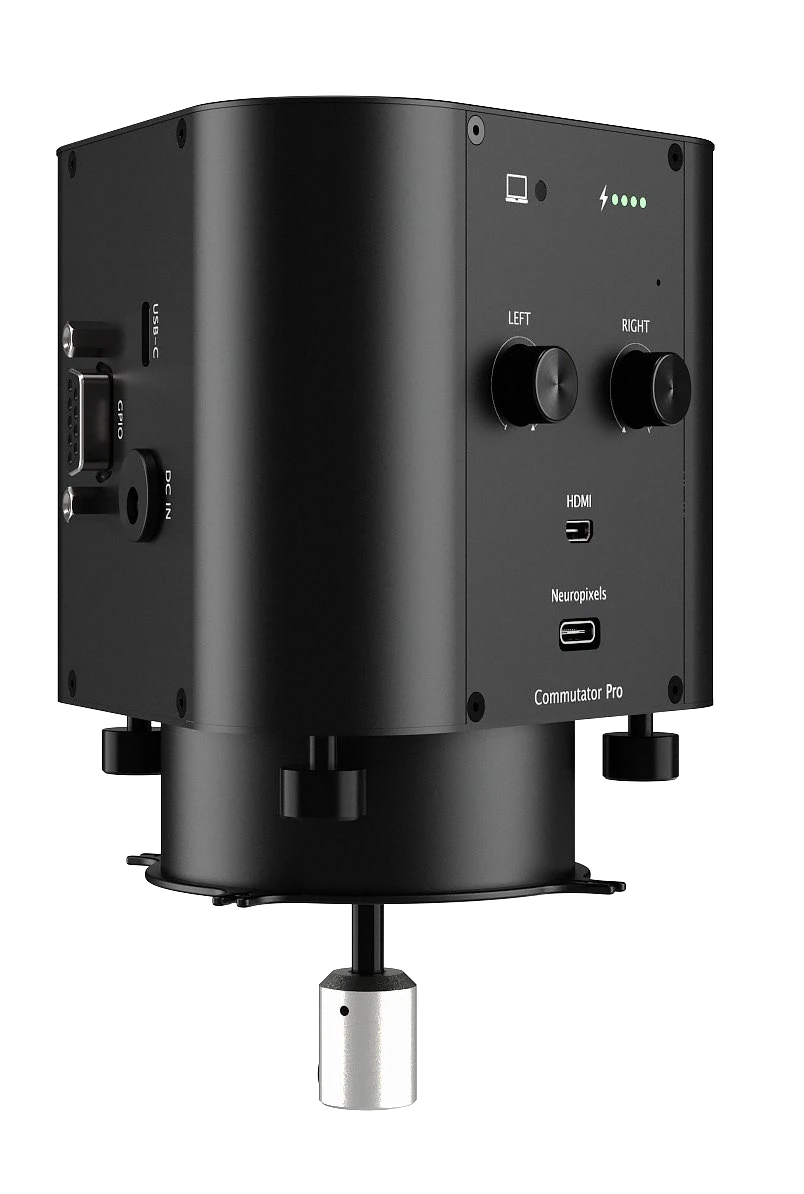
Commutator PRO
Motorized commutator · Neuropixels, HDMI or Dual Mode · IMU or Hall sensing
- Models
- Neuropixels, HDMI, or Dual Mode Commutator PRO
- Torque Sensing
- Gyroscope on the animal (I/IH), follows its turn; or Hall sensor on the rotor (M), reads the twist
- IMU Data Out
- Orientation and motor position over USB, JSON, every 20 ms (firmware 1.2; gyro configurations)
- Neuropixels Ports
- 1, 2 or 4; up to 2 with an HDMI port (Dual Mode)
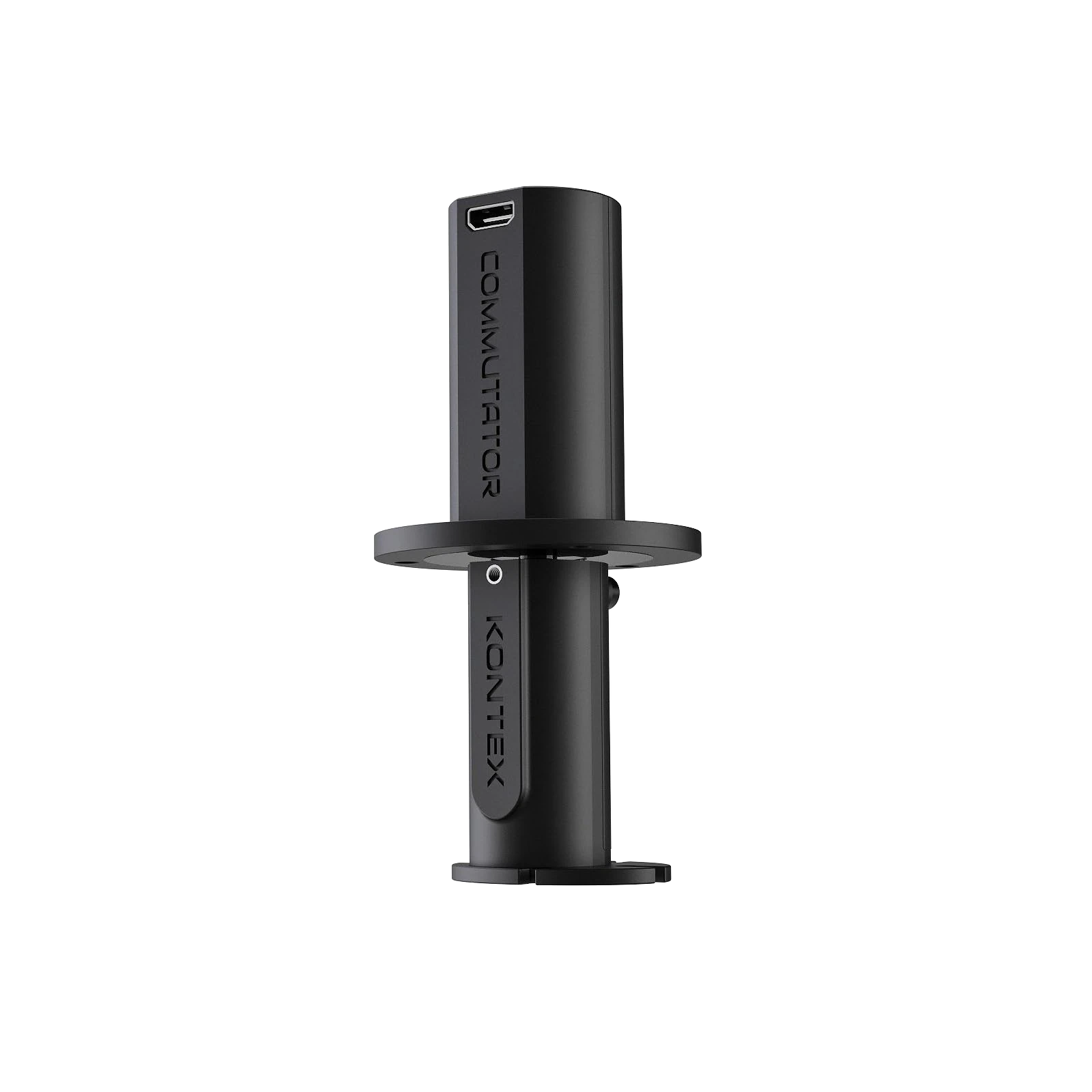
Standard Commutator
Non-motorized commutator · XR 256ch / XSR 32ch · plug-n-play
- XR Headstages
- Recording, up to 256 ch/cable
- XSR Headstages
- Stim-record, up to 32 ch/cable
- Power
- None — no external power
- Mounting
- 3.2 mm mounting hole
Optogenetics & Lasers
Laser and LED light sources for optogenetic stimulation, with GPIO triggering for precise timing against a recording.
Other Lab Equipment
Signal and test instruments (BrainSim), Smartbox accessories, and surgical tools that round out the rig.
Configured to Work Together
Every instrument here is characterized against NeuroNexus probes and streams through Radiens for probe-aware impedance and signal-quality monitoring.
Looking for headstages, adapters, cables, or reference electrodes? Those interface and accessory items now live under Supplies.
Equipment — FAQ
What equipment do I need beyond the probe?
At minimum, a way to position the probe and a headstage/acquisition path. Microdrives and manipulators handle placement; commutators keep freely-moving animals tethered without cable twist.
Is the equipment compatible with third-party acquisition?
Yes. The instruments work alongside Intan, Open Ephys, Plexon, TDT, and Blackrock setups — not only NeuroNexus acquisition.
Where did headstages and adapters go?
Interface and accessory hardware — headstages, adapters, cables, and reference electrodes — now lives under Supplies.
Can I combine optogenetics with recording?
Yes. Pair the light sources here with optoelectrodes; GPIO triggering aligns stimulation to the recording clock for sub-millisecond timing.