
Silicon Neural Probes
Silicon probes for recording and stimulation: 210+ catalog designs, 4 to 1,024 sites, fabricated and tested in-house.
Silicon probes record and stimulate through sites patterned on a thin silicon shank by integrated-circuit methods, so one insertion samples many known depths at once. NeuroNexus neural probes are the Michigan probe line: 210+ catalog designs, made and tested in our own facility since 2004.
Silicon probes by family
Eleven families. Each card states the trade its layout makes; the glossary term explains it, the webstore lists the designs.
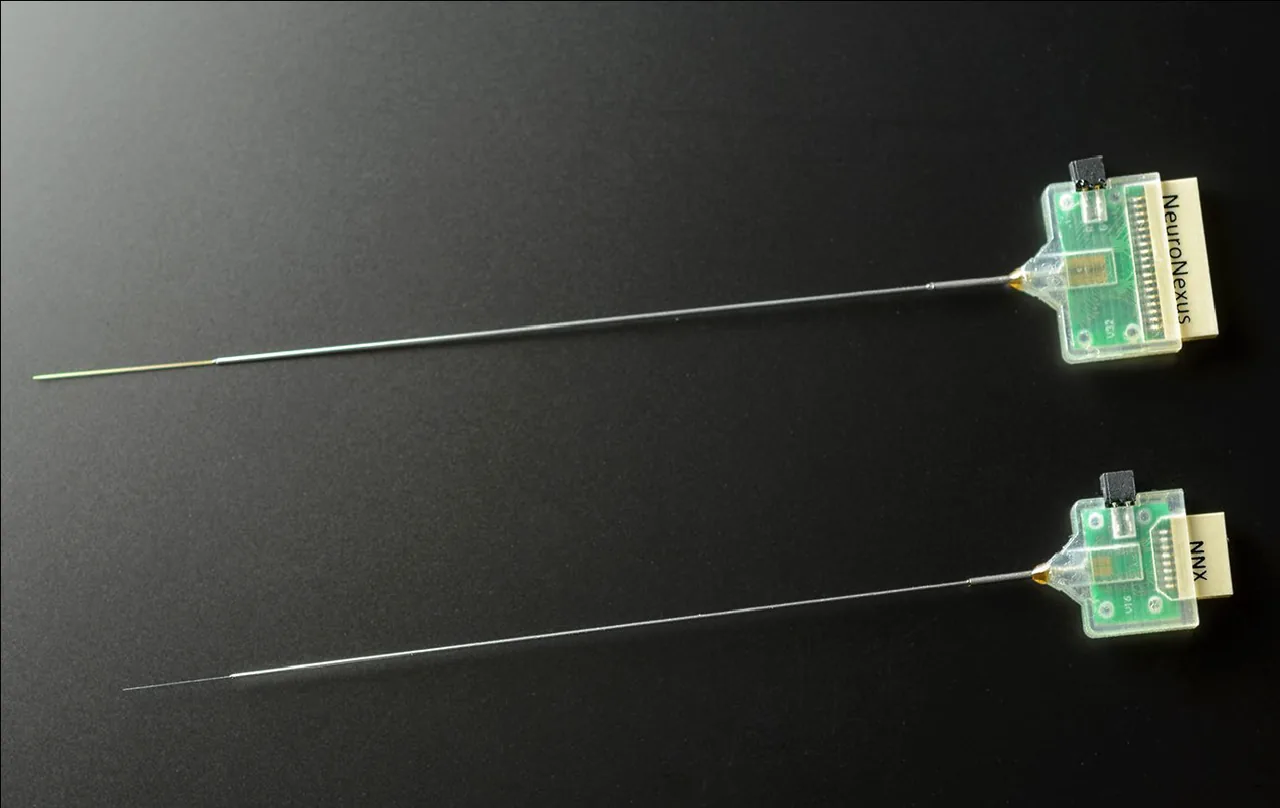
Vector Array
Short silicon array on a rigid support body — deep targets in large animals

Fusion
Electrode sites on both faces of the shank — the site count doubles in the same cross-section

Matrix Array Series
Silicon 3D probe platform — several 32-site 2D arrays, 64 to 256 channels, recording and stimulating

A-Series
Sites spread along the shank — linear and edge layouts for depth profiling
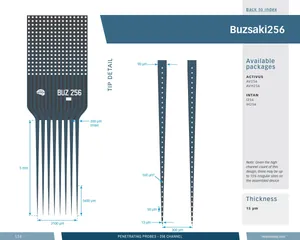
A-Series (Buzsaki)
Staggered sites concentrated at the tip — many units resolved from one penetration

A-Series (Isomura)
Parallel shanks at a pitch fixed in fabrication — the same layer across several columns

A-Series (Polytrode & Tetrode)
Sites clustered rather than spread — polytrode and tetrode groups a sorter can separate

Q-Trode Series
Four sites clustered at one depth — isolation by amplitude ratio, not a depth profile
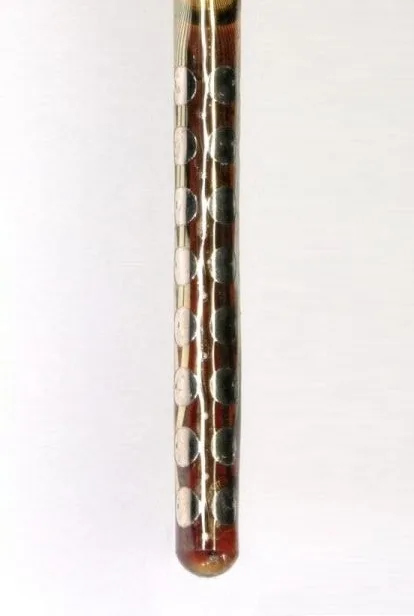
DBS Series
Clinical lead geometry with more and smaller contacts — 32 addressable along one shaft

Drug-Delivery Series
Stainless-steel fluidic channel beside the array — infuse and record at one site

HD Series (SiNAPS)
Active pixel under every electrode — digitized on the shank, 256 to 1,024 sites
Vector Arrays
Hybrid silicon and stainless steel microelectrodes for large-scale neural recording in primates and deep brain structures. Up to 128 channels with electrode access depths exceeding 100 mm — reaching targets that conventional silicon probes cannot.Vector Arrays combine the site density and spatial precision of silicon probes with the mechanical robustness required for chronic large-animal implantation.
Up to 128 Channels
High-density laminar recording across cortical layers and deep nuclei.
110+ mm Depth Access
Reach deep brain targets in primates and large animals.
Chronic Implantable
Designed for long-term recording in freely moving animals.
Fusion Probes
Double-sided silicon probes with 360° electrode coverage and integrated optical waveguides for simultaneous optogenetic stimulation and electrical recording. Available in 32, 64, and 128 channel configurations.Fusion probes eliminate the need for separate optical fibers and recording electrodes — reducing surgical complexity and improving spatial co-registration between stimulation and recording sites.
360° Electrode Coverage
Double-sided site placement captures activity from all directions around the shank.
Integrated Optogenetics
Built-in optical waveguides for precise light delivery at recording sites.
Acute & Chronic
Available in both acute reusable and chronic implantable form factors.

Finding the right silicon probe
With 210+ designs, the portfolio is navigated by application, by geometry, or with our help.
Filter by site count, shank configuration, site spacing, application, and form factor.
Open the webstoreThe glossary entry: what a silicon probe is, its catalog facts, and the papers that established it.
Read the definitionSite materials, impedance, reuse, chronic stability, and what the layout changes.
Read the answersOur application scientists can help you select or design the optimal configuration for your experiment.
Request ConsultationEvery NeuroNexus probe is fabricated, assembled, and electrically characterized in our own facility — the same facility where the Michigan probe was first manufactured. No third-party fabrication. Full traceability from wafer to packaged device. Acute probes are validated for 50+ reuses.
Your probe determines which headstage and DAQ you need. Every NeuroNexus probe includes a headstage compatibility specification — connector type, channel count, and impedance range are matched at the design stage. Need help building the recording chain? Start with your probe and we'll recommend the rest.
Better Data Starts at the Electrode
Radiens knows your probe — its geometry, channel map, and expected electrical characteristics. When you record with a NeuroNexus probe through Radiens, you get real-time signal quality assessment tuned to the specific device in your experiment.That's the advantage of vertical integration: the company that fabricated the electrode also wrote the software that evaluates its performance.

Proven in the Field
5,000+ Papers
Peer-reviewed publications using NeuroNexus probes
1,000+ Labs
Research institutions across six continents
210+ Designs
Validated probe configurations in the current catalog
22 Years
Continuous production from the team that built the Michigan probe
Cited in published research
Published work with silicon neural probes
More than 5,100 peer-reviewed papers cite NeuroNexus electrodes. Representative examples include:
Headley, Kyriazi, Feng, Nair & Paré (2021) · The Journal of Neuroscience
Gamma oscillations in the basolateral amygdala: localization, microcircuitry, and behavioral correlates
DOIAngotzi et al. (2019) · Biosensors and Bioelectronics
SiNAPS: an implantable active pixel sensor CMOS-probe for simultaneous large-scale neural recordings
DOIVetter et al. (2004) · IEEE Transactions on Biomedical Engineering
Chronic neural recording using silicon-substrate microelectrode arrays implanted in cerebral cortex
DOIKipke, Vetter, Williams & Hetke (2003) · IEEE Transactions on Neural Systems and Rehabilitation Engineering
Silicon-substrate intracortical microelectrode arrays for long-term recording of neuronal spike activity in cerebral cortex
DOIDrake et al. (1988) · IEEE Transactions on Biomedical Engineering
Performance of planar multisite microprobes in recording extracellular single-unit intracortical activity
DOIWise, Angell & Starr (1970) · IEEE Transactions on Biomedical Engineering
An integrated-circuit approach to extracellular microelectrodes
DOICare, use and handling
Setup, handling, cleaning and storage for silicon probes are documented once, in the resource library.
Inspect, measure impedance, mount, connect, verify, clean in order, store. Never ultrasonic, never autoclave.
Open the documentThe set by electrode class: silicon probes and thin-film grids, with the surgical guides each links to.
Open the hubSilicon probes — FAQ
How is the probe portfolio organized?
By design family — geometry, channel count, shank configuration, and application — across 210+ validated silicon designs. Filter by any of these in the webstore.
How many channels are available?
Probe designs span 4 to 1,024+ channels, from single-shank linear arrays to high-density and 3-D multi-shank configurations.
Can I get a custom probe?
Yes — custom geometry, materials, and packaging are designed and fabricated in-house; talk to an application scientist to scope one.
Silicon probe or silicone probe?
The material is silicon, the semiconductor the shank and its electrode sites are fabricated on; "silicone", the polymer, is a common misspelling. A NeuroNexus silicon probe is a microelectrode array for recording or microstimulation.
Where do I see specs and pricing?
Open the webstore filtered to probes and compare channel count, site geometry, and configuration.