Matrix Array™
A silicon 3D probe platform: 64 to 256 channels across a volume of tissue, up to 10 mm deep
Recording in Three Dimensions
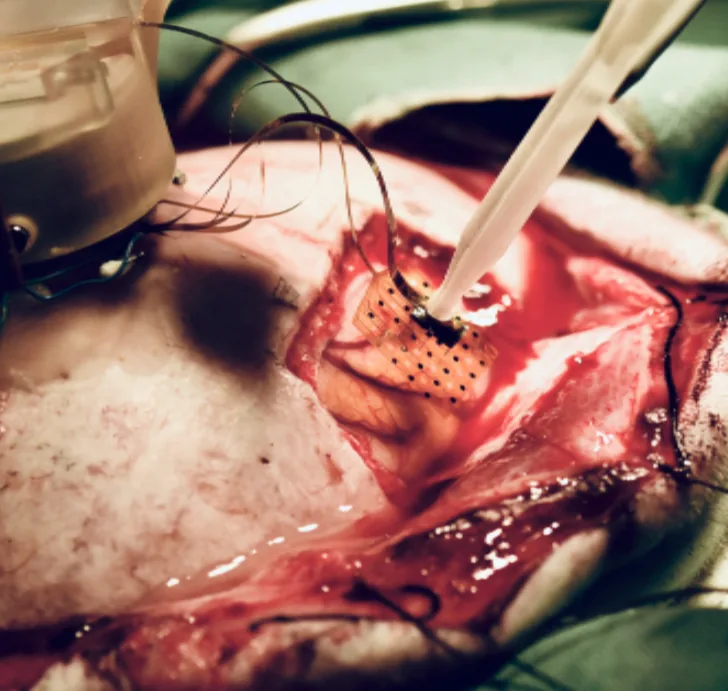
Several 32-site 2D arrays sit in slots on one platform and connect through a flexible cable to percutaneous connectors. A single implant samples across cortical columns and down through layers, in small animals and in non-human primates, acute or chronic.
Two Choices, Made Independently
The arrays and the spacing between them are chosen separately, so the platform is shaped to the anatomy rather than the anatomy to the probe.
Mix array designs on one platform
Unlike a multi-shank probe cut from one wafer, the arrays need not share a design.
- Short and long arrays to reach a sulcus and the gyrus beside it
- One slot can take an ECoG grid for depth and surface together
Spacing sets the sampled volume
Platform spacing is specified at order, 300 to 1,000 µm, with the same arrays and channel count.
- About 1.5 mm³ at 300 µm
- About 3.0 mm³ at 600 µm
- About 5.0 mm³ at 1,000 µm
Each array is its own penetration
Plan the surgical approach across the whole footprint, not only at the platform center.

Configure a Matrix Array in Three Decisions
A package, its 2D arrays and a platform spacing define the orderable Matrix Array.
01.
Select the package
The package sets the slot count, the connector and the covering, for your preparation and species.
- 2 slots: 64 channels
- 4 slots: 128 channels
- 8 slots: 256 channels (Activus)
02.
Select a 2D array for each slot
Each 2D array carries 32 sites; combine designs, or place an ECoG grid in a slot.
03.
Specify the platform spacing
300, 400, 600, 800 or 1,000 µm between arrays, stated when you order.
Specifications
| Matrix Array | |
|---|---|
| Channels | 64, 128 or 256, in 32-site 2D arrays |
| Depth | Up to 10 mm, by array design |
| 2D arrays | 1 to 4 shanks, 2 to 12 mm long, on 50 µm silicon |
| Sites | 177, 413 or 703 µm², iridium |
| Layouts | Linear, edge, Poly3 and Buzsaki layouts in the catalog |
| Platform spacing | 300 to 1,000 µm, specified at order |
| Use | Recording and stimulation, acute or chronic; research use only |
The Package Range
| Package | Channels | Connector | Construction |
|---|---|---|---|
| MA64 · MA128 | 64 · 128 | Omnetics 32-pin ×2 or ×4 | UV epoxy, 22 mm cable |
| MCM64 · MCM128 | 64 · 128 | Omnetics 32-pin ×2 or ×4 | 3D-printed polymer case, 14 mm cable |
| MH64 · MH128 | 64 · 128 | Omnetics 32-pin ×2 or ×4 | 3D-printed polymer case, 36 mm cable |
| MMH64 | 64 | Omnetics 32-pin ×2 | UV epoxy, 36 mm cable |
| MHS64 · MMHS64 | 64 | Omnetics 32-pin ×2 | 3D-printed titanium housing, 36 mm cable |
| MHS128 | 128 | Omnetics 32-pin ×4 | 3D-printed titanium housing, 60 mm cable |
| MAVH128 · MAVH256 (Activus) | 128 · 256 | Micro-HDMI | Digitizing chips in a titanium housing, 60 mm cable; records only |
From Platform to Dataset
Packages are chosen with the probe, not sold separately. The connector then decides the headstage, and the headstage the acquisition system.
Passive packages
Each Omnetics 32-pin mates a SmartLink 32, or an X-Series headstage through an adapter.
Stimulation
An X-Series stim-record headstage on XDAQ drives stimulation through the same sites.
Activus packages
Intan RHD chips digitize in the package; XDAQ or Smartbox connects over micro-HDMI.
Software
The acquisition system synchronizes the headstages; Allego acquires and Radiens analyzes.
Matrix 2D Array Designs
Each design is one 32-site 2D array for a platform slot.
Matrix Array Series
A Matrix Array is a silicon 3D probe platform: several 32-site 2D arrays are installed in slots on a platform and connected through a flexible cable to percutaneous connectors, so the array designs and the spacing between them are chosen independently, at 64 to 256 channels and to 10 mm deep. This collection lists the Matrix 2D array designs: 1 to 4 shanks at 2 to 12 mm with 177, 413 or 703 µm² iridium sites on 50 µm silicon; the assembled platforms, passive and Activus, are under the Matrix package series.

Edge Single-Shank 31-Channel Probe, 3.2 mm
31-site Matrix array
- Platform
- Matrix Array (one 2D array per platform slot)
- Channels
- 31
- Shanks
- 1
- Shank length
- 3.2 mm
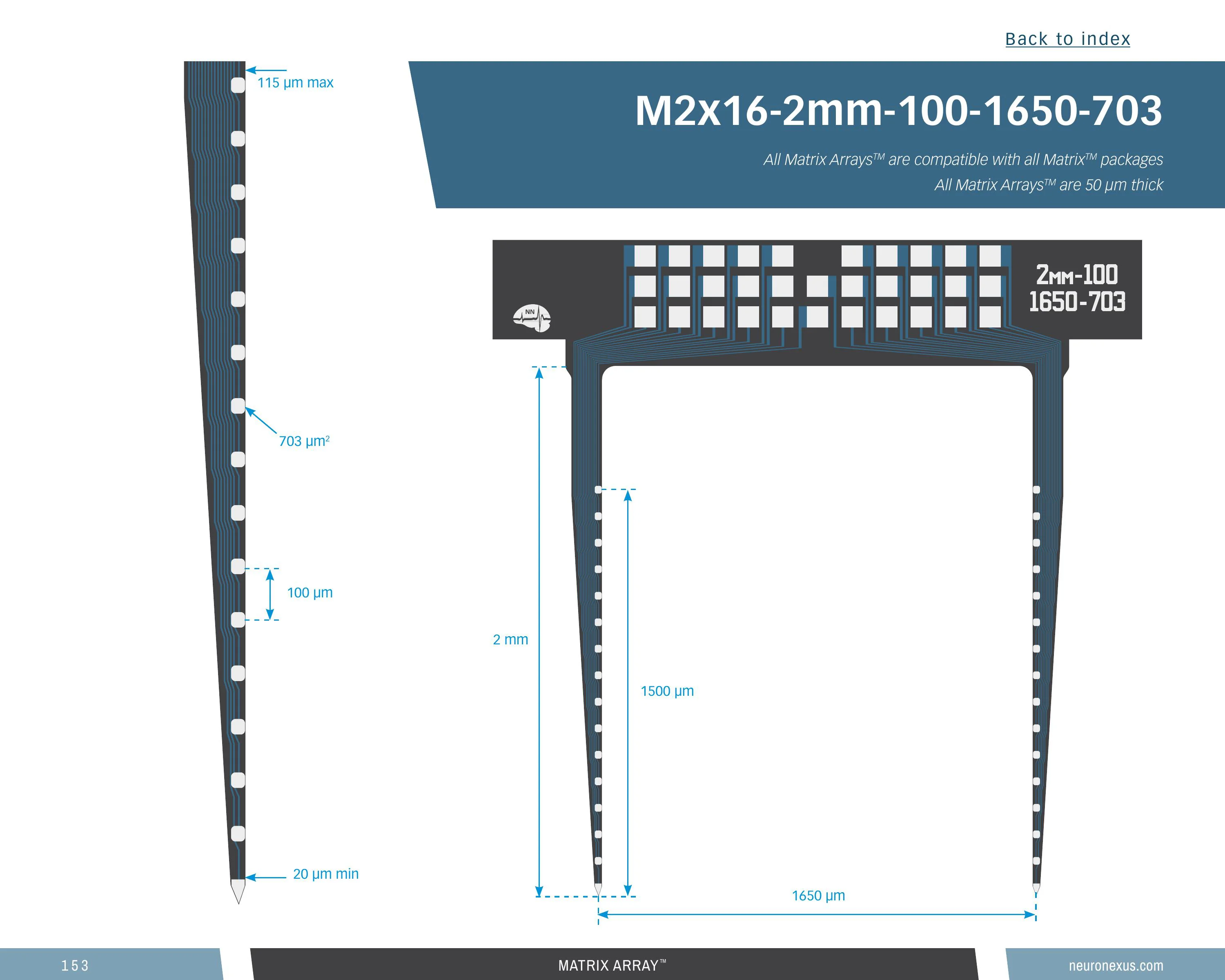
Linear 2-Shank 32-Channel Probe, 2 mm
32-site Matrix array, 2 shanks, 2 mm
- Platform
- Matrix Array (one 2D array per platform slot)
- Channels
- 32
- Shanks
- 2
- Shank length
- 2 mm
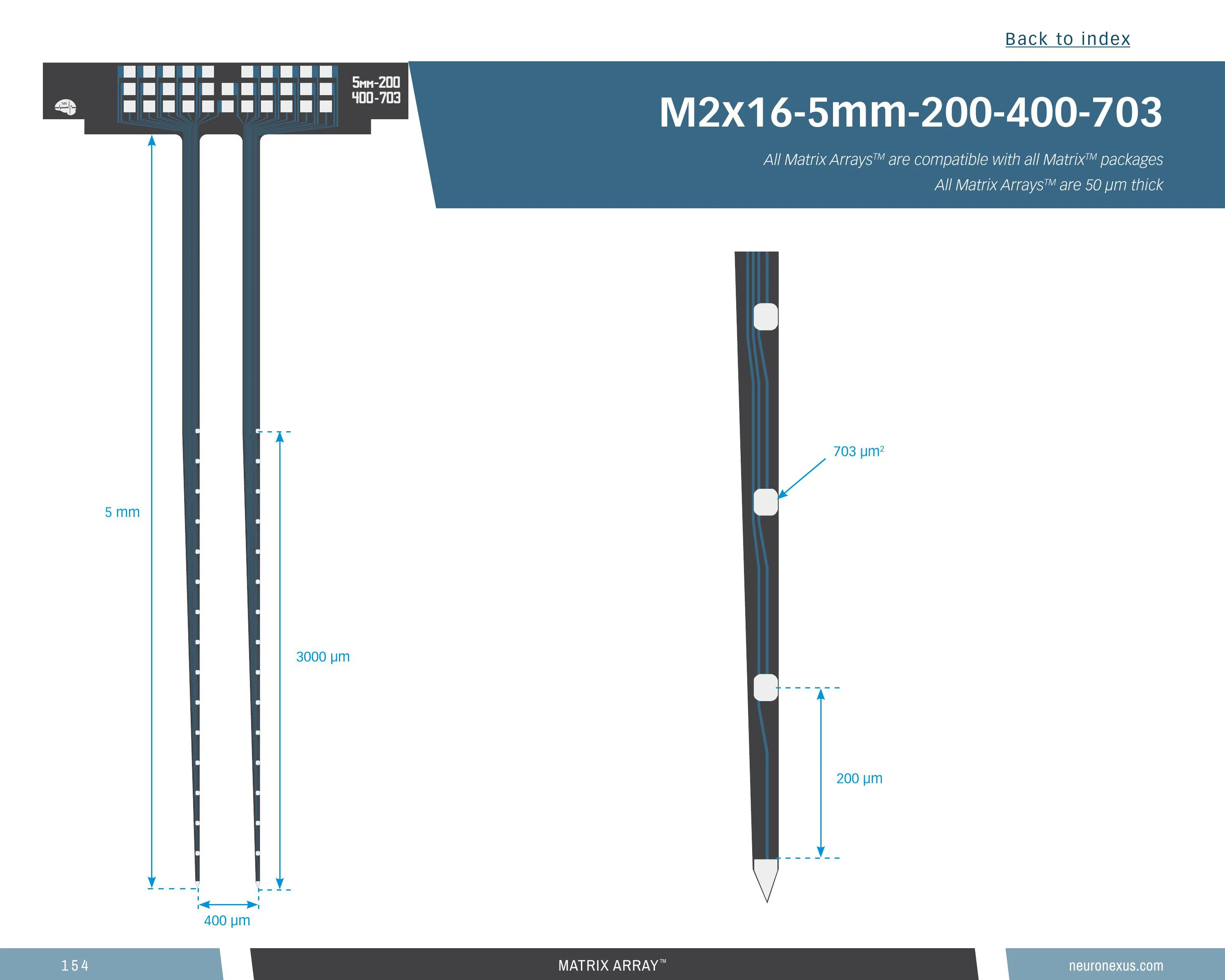
Linear 2-Shank 32-Channel Probe, 5 mm
32-site Matrix array, 2 shanks, 5 mm
- Platform
- Matrix Array (one 2D array per platform slot)
- Channels
- 32
- Shanks
- 2
- Shank length
- 5 mm
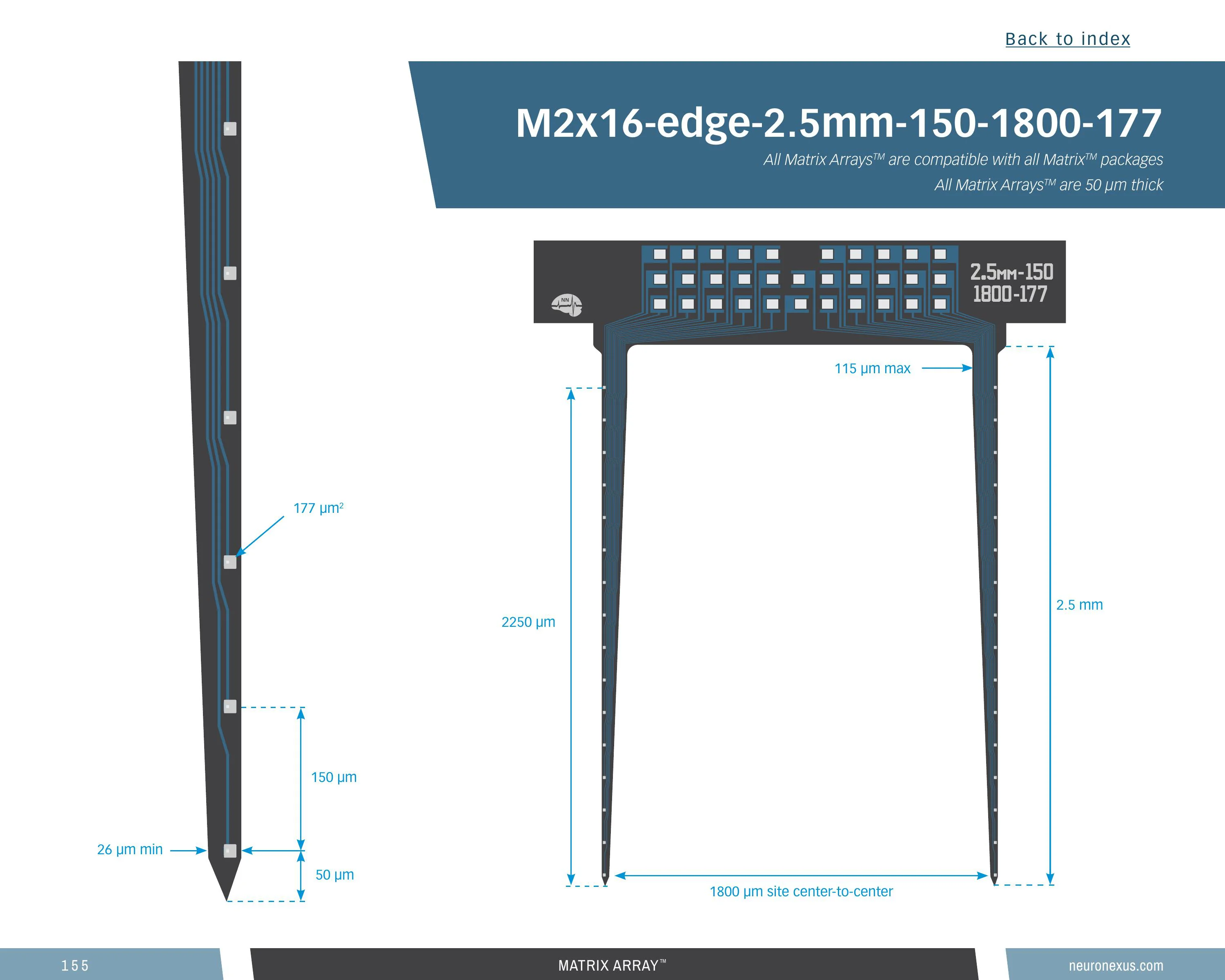
Edge 2-Shank 30-Channel Probe, 2.5 mm
30-site Matrix array, 2.5 mm
- Platform
- Matrix Array (one 2D array per platform slot)
- Channels
- 30
- Shanks
- 2
- Shank length
- 2.5 mm

Edge 2-Shank 30-Channel Probe, 4 mm
30-site Matrix array, 4 mm
- Platform
- Matrix Array (one 2D array per platform slot)
- Channels
- 30
- Shanks
- 2
- Shank length
- 4 mm
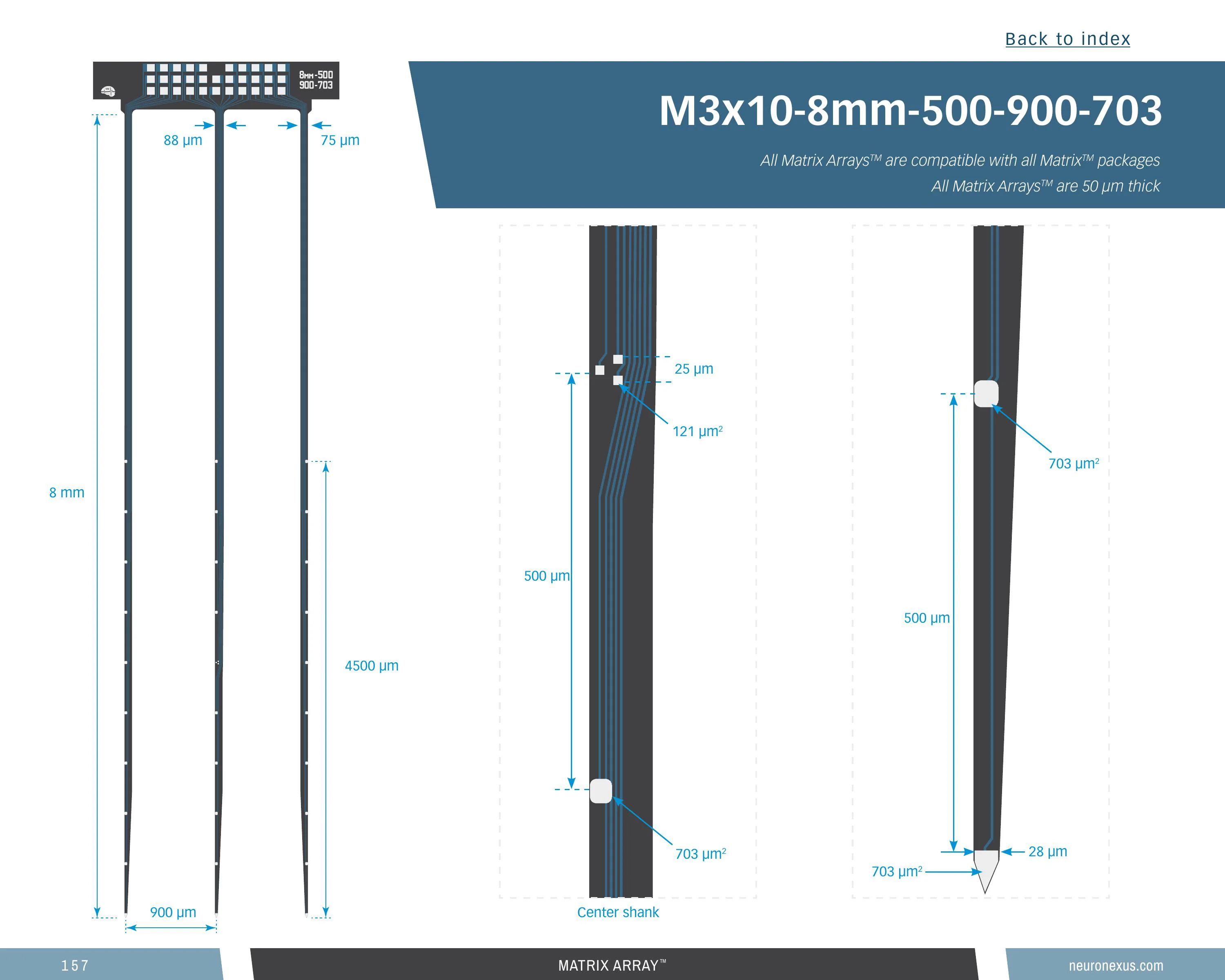
Linear 3-Shank 32-Channel Probe, 8 mm
32-site Matrix array, 3 shanks, 8 mm
- Platform
- Matrix Array (one 2D array per platform slot)
- Channels
- 32
- Shanks
- 3
- Shank length
- 8 mm
See a Matrix Array Configured and Implanted
Resources
Talk to a scientist about a Matrix Array
Tell us the target, the species and the volume you need to sample; we will propose the arrays and the spacing.
Matrix Array — FAQ
What is a Matrix Array?
A Matrix Array is a silicon 3D probe platform: several 32-site 2D arrays are installed in slots on a platform and connected through a flexible cable to percutaneous connectors, so the array designs and the spacing between them are chosen independently, at 64 to 256 channels and to 10 mm deep. It records and stimulates.
How does platform spacing change the sampled volume?
Platform spacing is specified at order, 300 to 1,000 µm, and sets the volume the same arrays sample: about 1.5 mm³ at 300 µm, 3.0 mm³ at 600 µm and 5.0 mm³ at 1,000 µm, with the same channel count. Each 2D array is a separate penetration, so the surgical approach is planned across the whole footprint.
Can I mix 2D array designs, or add an ECoG grid?
Yes. Unlike a multi-shank probe cut from one wafer, the arrays in a platform need not be the same design, and one slot can take an ECoG grid. Catalog 2D arrays have 1 to 4 shanks at 2 to 12 mm, with 177, 413 or 703 µm² iridium sites on 50 µm silicon.
Passive or Activus package?
Passive builds route the arrays to two or four Omnetics 32-pin connectors at 64 or 128 channels; each connector mates a SmartLink 32 headstage directly or an X-Series headstage through an adapter, and stimulation uses an X-Series stim-record headstage on XDAQ. The Matrix Activus builds (MAVH128, MAVH256) integrate the Intan digitizing chips in the package and connect to XDAQ or Smartbox over micro-HDMI with no separate headstage; they record only.
Acute or chronic?
Both. A Matrix package terminates in a percutaneous connector for acute and chronic recording and stimulation in small and large animals, including non-human primates, on a 14 to 60 mm cable in UV epoxy, a 3D-printed polymer case or a titanium housing.