Getting Started with NeuroNexus
Overview of NeuroNexus products and solutions.
11 min read
Updated October 9, 2026
[TOC]
Getting Started with NeuroNexus#
NeuroNexus makes electrodes, instruments, and software for electrophysiology: a catalog of thousands of probe and array variants; custom designs when the catalog doesn't fit your target; and Radiens software, free to start. Engineered together — and usable à la carte.
Company at a glance#
NeuroNexus is a full-stack electrophysiology company: electrodes, instruments, and software for neural recording and stimulation, engineered together — and usable à la carte. The electrodes are thin-film microelectrode arrays — silicon probes that penetrate the brain, spinal cord, nerves, ganglia, or heart, and flexible polymer grids that record from the surface of the cortex, the skull, the heart, or a peripheral nerve — in a catalog of thousands of probe and array variants, with custom designs when the catalog does not fit the target. The instruments are the headstages and acquisition systems that read them, and the software is Radiens, which is free to start. Founded in 2004 as a spin-out of the University of Michigan and based in Ann Arbor, Michigan, NeuroNexus has spent 22 years on neural-interface technology; it is cited in 5,000+ peer-reviewed publications and in use in 1,000+ laboratories across six continents, in preparations for acute and chronic in vivo studies to organoids and brain slices, and in species from fruit flies to non-human primates.
See more about the company at About us ↗.
Key attributes include:
- Global commercial business in life science and neurosurgery research
- Spun out of the University of Michigan in 2004
- Acquired by Integer in 2012 (public med-tech company)
- Acquired by NEL Group, Inc. in 2019 (private investment company consisting of a few individual investors--including founders--each with deep knowledge of neurotechnology)
- 19 people: 9 engineers & scientists (3 PhDs), 7 production specialists
- Strong IP and technology platforms
Interacting with us#
We are a small neurotechnology company driven by our interest in the field. If you have a question, an issue, or an idea for an experiment, we consider it worth exploring—there's no cutoff for what is worth asking or discussing.
- Contact us ↗
- support@neuronexus.com ·
- +1.734.913.8858
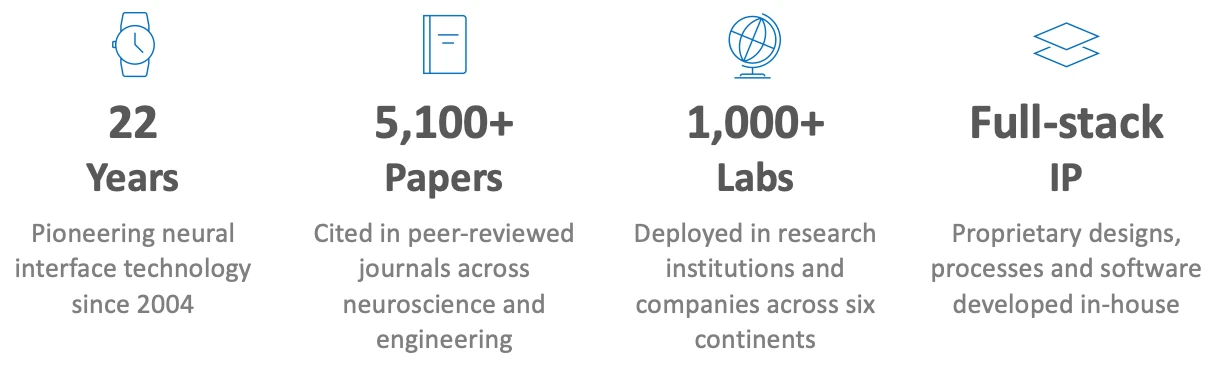
Figure 1. NeuroNexus at a glance: 22 years pioneering neural-interface technology since 2004; 5,100+ peer-reviewed papers citing the technology across neuroscience and engineering; 1,000+ laboratories across six continents; and full-stack IP — proprietary designs, processes, and software developed in-house.
NeuroNexus Technology Platforms#
NeuroNexus develops solutions that accelerate neuroscience, neurological therapies, and drug discovery — from organoids to patients, in vivo and in vitro. The work spans the central nervous system, spinal cord, peripheral nerve, and heart in vivo; organoids and brain slices in vitro; and neurosurgery and neuromodulation in the clinic, across species from fruit flies to non-human primates. What connects them is one problem: the recording you can attempt is bounded by the electrode that fits your target, the instrument that reads it, and the software that makes sense of what comes back.
Three technology platforms address that problem, and they are engineered together (Figure 2). The electrode platform comprises thin-film probes and grids — a catalog of thousands of variants for diverse neural targets, plus custom designs for targets the catalog does not cover. The instrumentation platform comprises headstages and acquisition systems that record, stimulate, and close the loop, matched to the probes. The Radiens software platform takes a recording from acquisition through analysis, with quality and provenance carried across the whole workflow. Each is usable on its own alongside whatever a lab already runs; together they cover the path from the electrode to the answer.
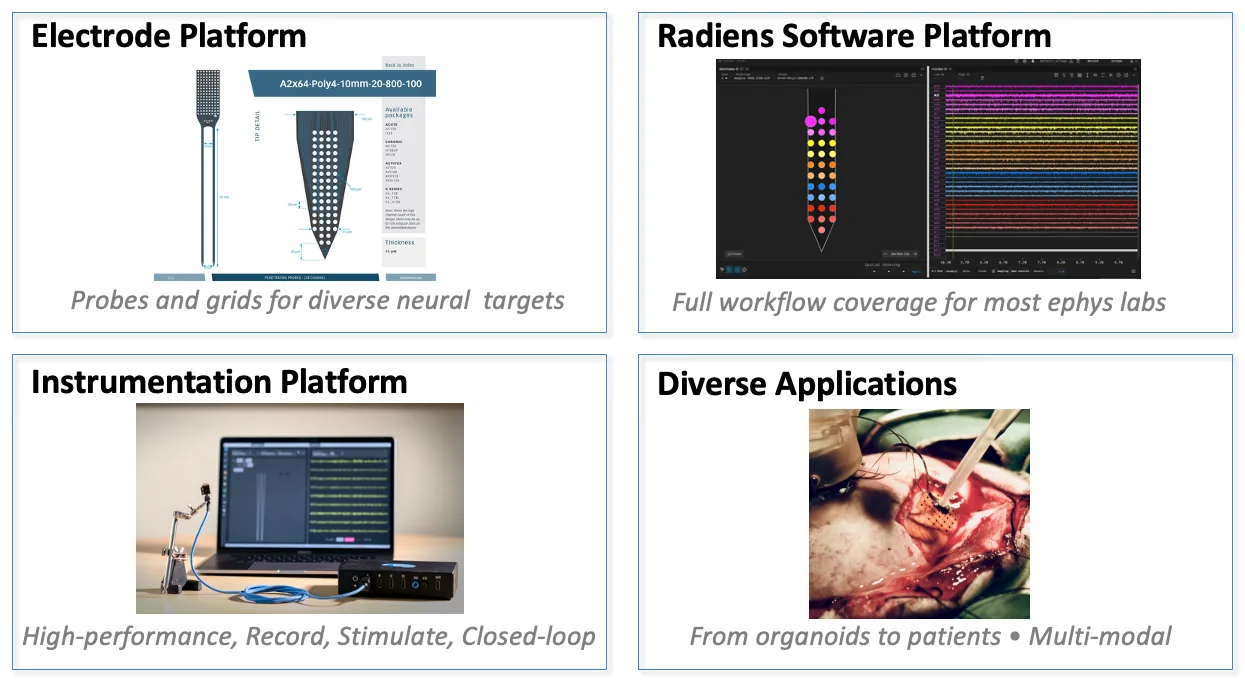
Figure 2. The NeuroNexus technology platforms. Electrode platform: silicon probes and thin-film grids for diverse neural targets. Radiens software platform: the workflow from recording to result. Instrumentation platform: headstages and acquisition systems that record, stimulate, and close the loop. Applications span organoids to patients.
Electrode Platform: Silicon Probes and Thin-film Grids#
NeuroNexus makes two types of thin-film electrodes for different neural or cardiac targets (Figure 3). Silicon probes are micro-scale devices with thin shanks that penetrate the brain, spinal cord, nerves, ganglia, or heart to place electrode sites close to internal structures. Thin-film grids are thin, flexible polyimide devices placed on the surface of the brain, skull, spinal cord, nerve, or heart to record surface biopotentials. Both are made by thin-film microfabrication—thin conductive and insulating layers deposited on a substrate and patterned by photolithography—so each device's geometry is fixed by a mask set, reproducible from unit to unit, and designed against the target rather than adapted to it. The probe catalog holds 216 silicon probe designs in ten families and 53 grid designs in four. The Silicon Probes and Thin-Film Grids introduction covers the electrode platform in depth.
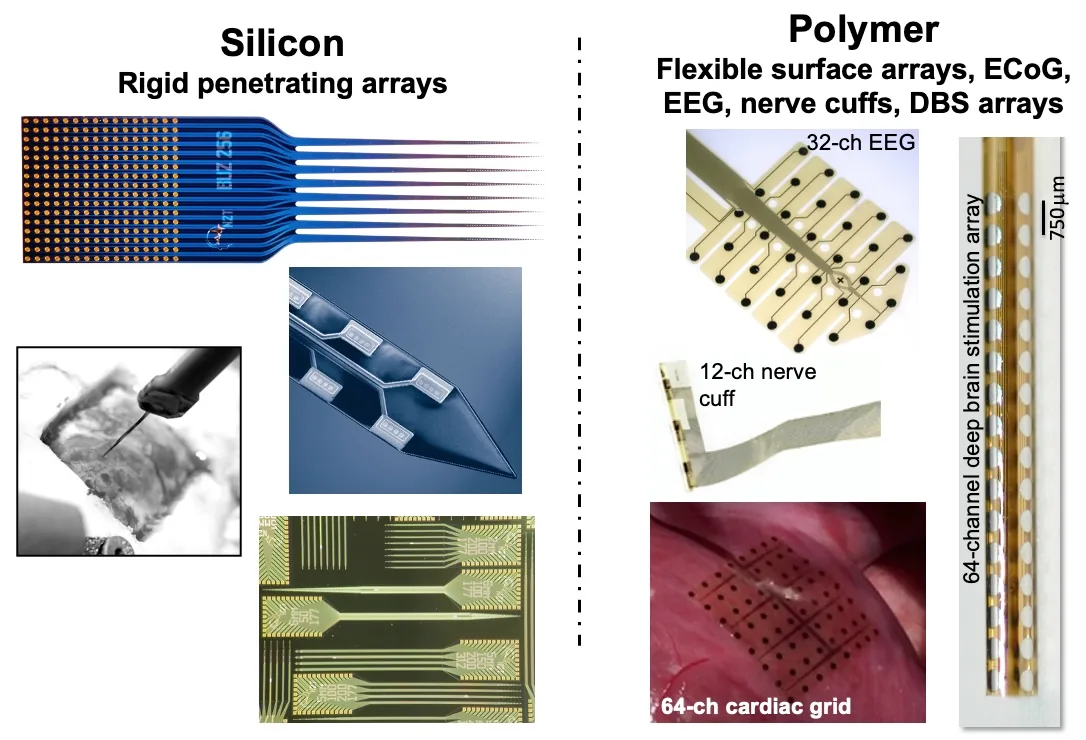
Figure 3. The two electrode platforms. (Left) Silicon — rigid penetrating arrays: a 256-site Buzsáki-layout probe die, a shank tip with its electrode sites, insertion into tissue, and dies on the wafer. (Right) Polymer — flexible surface arrays: a 32-channel EEG grid, a 12-channel nerve cuff, a 64-channel cardiac grid, and a 64-channel deep brain stimulation array.
Radiens Software Platform#
Radiens is NeuroNexus's electrophysiology software: free to open, read, and convert any lab's data; Pro for professional analysis and for scaling a working lab; and Radiens Services when you want our scientists working alongside you. It spans the workflow from recording to result, in vivo and in vitro: Allego records in real time with live signal-quality metrics at the rig, and Videre opens the data afterward in linked spatial and visual views where structure is apparent at a glance. It runs locally—the data stays in the lab's own storage—with quality and provenance carried across the whole workflow, so results stay yours and reproducible. Any acquisition stream can be read live, and the newest probes are first-class (Figure 4). See Radiens ↗ for more information.

Figure 4. Allego, the Radiens real-time acquisition application, at the rig: the electrode map of a 32-site A1x32-Poly3 silicon probe (left) beside the live signal monitor (right), 32 channels streaming through an XDAQ headstage.
Instrumentation Platform#
The instrumentation platform is engineered for high performance, reliability, future-proofing, and affordability. It features headstage amplifiers, data acquisition systems, and fully integrated software, along with support components for both complete systems and modular use. The platform offers plug-and-play compatibility with all NeuroNexus electrodes and excellent support for Neuropixels and SiNAPS, as well as most third-party electrodes. It supports multimodal functions, including neural recording, electrical stimulation, optogenetic stimulation, and synchronization with behavioral and related equipment. Scalability is a key feature: from single electrodes to systems with four or more, and from 1 to over 1,500 channels. It is open-source and compatible with most acquisition streams, enabling seamless integration with existing lab setups. See Instrumentation ↗ for more information.
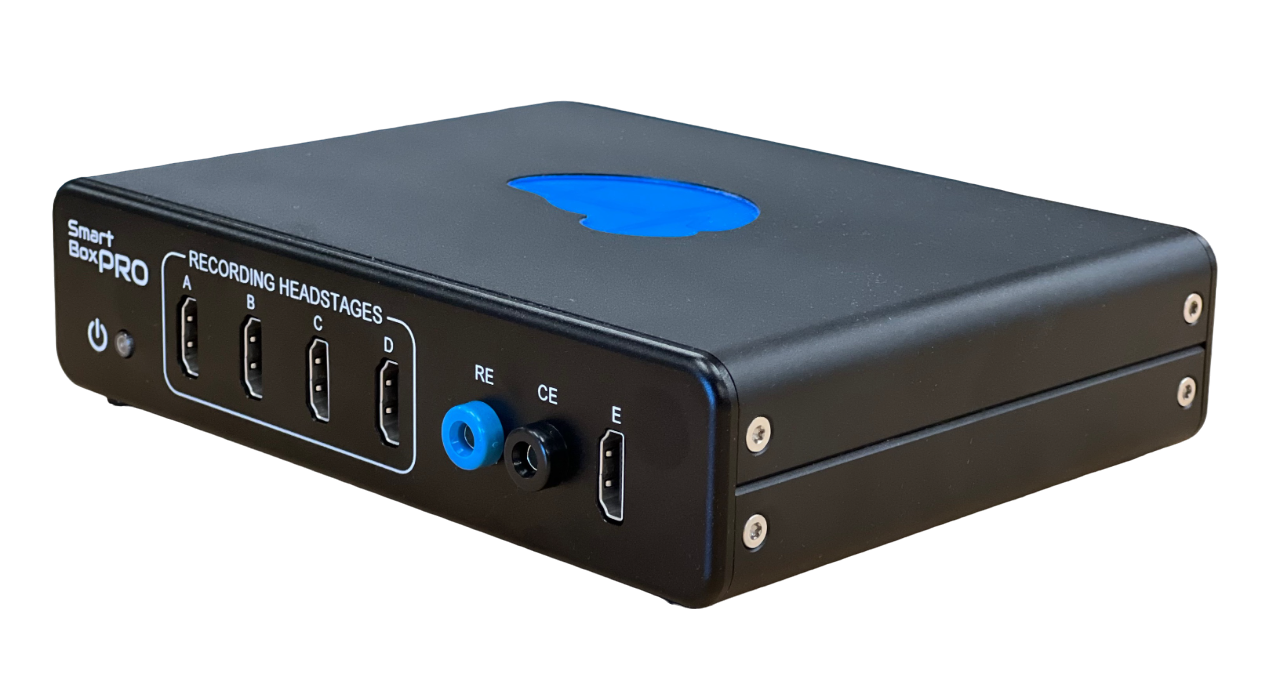
Figure 5. Smartbox Pro acquisition system, front panel: four recording-headstage ports (A–D).
Applications and Solutions#
NeuroNexus electrodes, instrumentation, and software are used worldwide in diverse types of studies using in vivo and in vitro models. In vivo uses include cortex, deep brain, hippocampus, spinal cord, peripheral nerve, ganglia, and heart, in both acute and chronic setups across species from mice to NHPs. In vitro involves organoids and brain slices. Solutions are tailored per protocol rather than sold as fixed configurations — selecting probe geometry based on the target, choosing a package for the specific preparation, and matching the headstage and acquisition system to the rig. We use Radiens for recording and analysis, with application scientists helping match probes to each setup. When no catalog geometry fits, we create custom designs using the same process (Figure 6). See Solutions ↗ for more information.
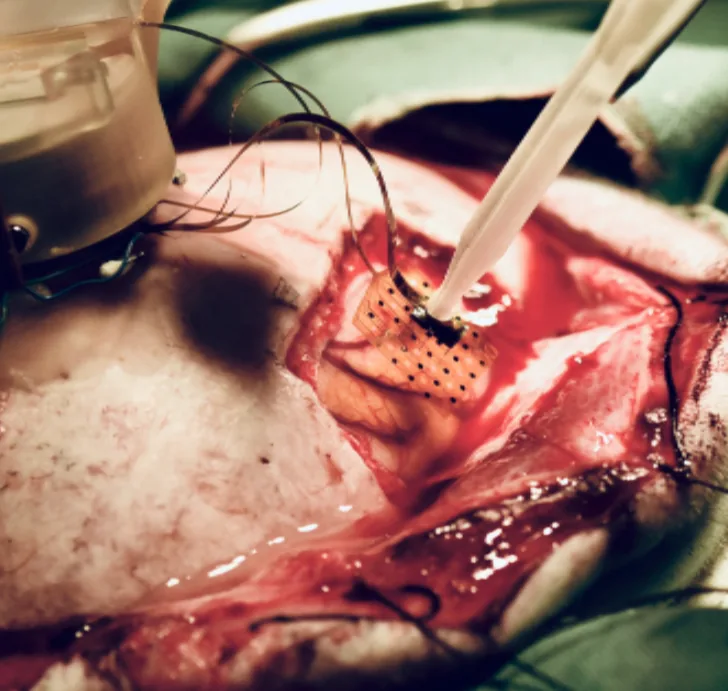
Figure 6. A NeuroNexus Matrix 3D electrode array inserted into cerebral cortex in a large-animal preparation. In this application, the Matrix array was combined with a separate ECoG thin-film grid for multi-modal and multi-scale neural recordings.
NeuroNexus Research#
NeuroNexus runs an active, peer-reviewed research program, NIH-funded and carried out with collaborators including Harvard, Mayo Clinic, and Purdue. It serves three purposes.
- It pushes the technology past what the catalog can do today, and the results become the next products.
- It makes us our own most demanding customer: every probe, instrument, and software release is run first on our own benches and in our own preparations, under the conditions a lab will meet.
- And it is the reason the company exists — the people here are neuroscientists and engineers who work on neural interfaces because the problems interest them and because the field matters, to research now and to therapies later.
See New solutions R&D ↗ and Data analytics R&D ↗ for more information.
Where to go next?#
Websites#
Both websites are new, and they are the fastest way to understand what we make, how the pieces fit, and where we are headed.
- neuronexus.com ↗ — the company and the full catalog: probes, grids, packages, headstages, and acquisition systems, with a datasheet for every design, the glossary, and this resource library. The Now ↗ page shows what we are working on.
- radiens.ai ↗ — a separate website backing the Radiens software platform: Allego and Videre apps, dashboards, downloads, documentation. Radiens Standard is free to download, install, and use.
Use cases#
Increase your focus on the science, not the tools — learn about using advanced software ↗ and hardware ↗ tools to better support your work, with low-friction adoption into existing workflows
Choosing an electrode — the Silicon Probes and Thin-Film Grids introduction ↗ for information on electrodes and general approaches for electrode selection; then How an Electrode Records Neural Activity for the background, Choosing an Electrode for Your Experiment and Choosing a Probe Package for the decisions, and The Electrode Design Space for the full range of designs.
Browse to learn what exists and what's possible— browse the webstore ↗ and product datasheets for designs and packages; consult the glossary ↗ for technical terms and information; learn about the latest solutions for high-density and large-scale recordings ↗.
Building the rig — learn how Radiens ↗ fits into new and existing workflows to make complex work easier and reproducible; learn about cost-effective data acquisition solutions ↗ for increased capabilities with low-friction adoption.
Probe in hand — start with Silicon Probes: Setup, Handling, Cleaning and Care or Thin-Film Grid Electrodes: Setup, Handling, Cleaning and Care, then consult our large knowledge base of technical resources ↗ for training, surgical guides, troubleshooting, and advancing your work.
See your data in the moment — learn how to get the most out of every procedure with live monitoring and real-time quality metrics ↗ using Radiens software.
Looking for custom solutions — contact us with ideas and requirements for your planned or current experiments.