Mouse EEG Electrodes and Grids
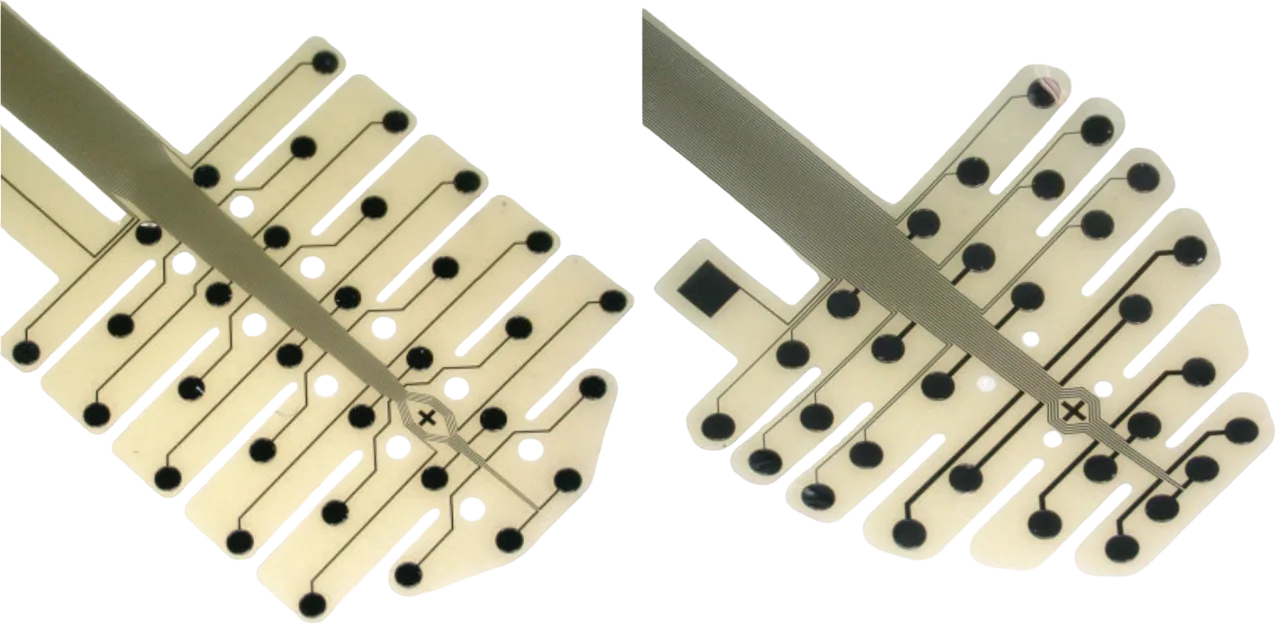
Thin-film EEG grids for the mouse skull: 16, 30 or 32 platinum sites aligned to bregma, placed with no craniotomy.
Cited in published research
The mouse EEG grids
Select a grid by site count and cable length; each opens its datasheet.
| Grid | Sites | Site outline | Cable | Packages | Availability |
|---|---|---|---|---|---|
| EEG 30-Channel GridEEG-M-30-A-CL10 | 30 | 6.9 × 8.8 mm | 10 mm | H32 + 5 more | |
| EEG 30-Channel GridEEG-M-30-A-CL7 | 30 | 6.9 × 8.8 mm | 7 mm | H32 + 5 more | |
| EEG 30-Channel GridEEG-M-30-A-CL8 | 30 | 6.9 × 8.8 mm | 8 mm | H32 + 5 more | |
| EEG 32-Channel GridEEG-M-32-B-CL10-RET | 32 | 8.0 × 6.5 mm | 10 mm | H32 + 5 more | |
| EEG 16-Channel GridEEG-M-16-CL10 | 16 | 7.5 × 8.1 mm | 10 mm | H16 + 5 more |
The grid
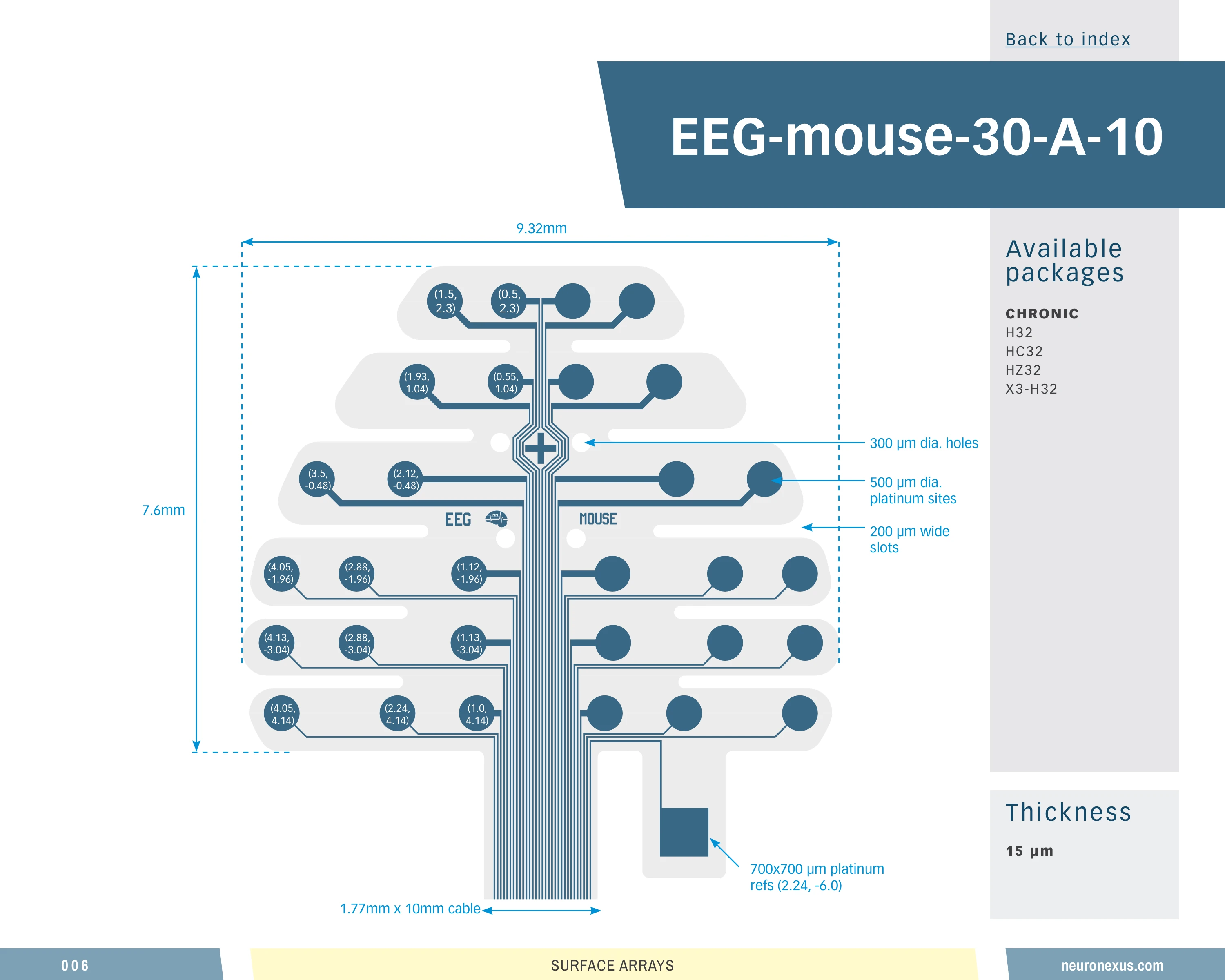
A 12 µm polyimide film carries 500 µm platinum sites drawn to the mouse skull, so each site lands on the same region in every animal.
No craniotomy
The film sits on the intact skull; bone screws clear of the grid carry the load and give ground and reference.
Aligned to bregma
A crosshair on the film aligns to bregma, so placement is one step and repeats from animal to animal.
Weeks to months
The implant holds for weeks to months, so spectral and coherence measures follow the same animal.
Freely moving
The grid ends in an H32 or H16 Hybrid package and a headstage, for recording awake, freely moving mice.
What it connects to
Each grid mates directly with a NeuroNexus headstage and records on any NeuroNexus acquisition system, with no adapter.
01.
Package: H32 or H16
The 30- and 32-site grids end in an H32 Hybrid package, the 16-site grid in an H16; both are Omnetics.
02.
Headstage: SmartLink or X3R
An H32 mates SmartLink 32 or X3R 32; an H16 mates SmartLink 16.
03.
Commutator, for long sessions
A Standard Commutator or Commutator PRO keeps the tether from twisting as the mouse moves.
04.
Acquisition: SmartBox Pro or XDAQ
Each of these headstages runs on SmartBox Pro and on XDAQ ONE+, CORE2 and ALL-IN-ONE.
05.
Software: Allego and Radiens
Allego acquires and Radiens analyzes on every one of these systems.
How to choose
The choice turns on how many places on the skull the question needs, and how alike they must be between animals.
Bone-screw electrodes
One channel per screw, placed by hand: the simplest route to a seizure count or a sleep score.
Thin-film grid
16 to 32 sites placed in one step on the same region in every animal, for spectral and coherence phenotypes.
Wireless headmount
No tether, but the transmitter sets the channel count, usually a few channels on screw electrodes.
Published with these grids
Mouse studies on the 30-site grid, and the rat layout of the same series.
Mouse EEG — FAQ
Does a mouse EEG grid need a craniotomy?
No. The thin-film grid sits on the intact skull over the recording area, with no bone removed. Bone screws placed clear of the grid anchor the implant and provide the ground and reference, and the grid is cemented at its edges and at the cable exit.
How long does a mouse EEG grid implant last?
It records for weeks to months, so a biomarker can be followed through development, or a treatment measured against a baseline, on the same implant. Impedance that rises over weeks usually means the cement is lifting at an edge.
Which acquisition system does a mouse EEG grid need?
The 30- and 32-site grids end in an H32 Hybrid package that mates a 32-channel headstage such as SmartLink 32 or X3R 32; the 16-site grid ends in an H16 for SmartLink 16. Each runs on Smartbox Pro or XDAQ, with Allego for acquisition and Radiens for analysis.
Can a mouse EEG grid be reused?
Yes. Jonak et al. (2018) describe a reusable 30-channel technique for EEG in awake, freely moving mice on the NeuroNexus mouse grid. Handling and cleaning between uses are in Thin-Film Grid Electrodes: Setup, Handling, Cleaning and Care.
Matching a grid to your rig
An Application Scientist can match the package and headstage to your acquisition system, and replies within one business day.