Neuropixels, SiNAPS and Silicon Probes: How to Choose
Neuropixels alternatives compared on published numbers: Neuropixels 1.0 and 2.0, SiNAPS active-pixel probes, and dense passive silicon probes, side by side.
8 min read
Updated October 31, 2026

NeuroNexus · neuronexus.com · Resources
Neuropixels probes, made by imec, record 384 channels chosen from 960 to 5,120 sites, or 1,536 on the Quad Base. SiNAPS, the other active-pixel probe, records every one of its 256 or 1,024 sites at once. Dense passive silicon probes are functionally comparable for some applications and add stimulation. NeuroNexus offers SiNAPS and the passive designs, and the equipment and software that run Neuropixels.
Research use only. NeuroNexus products are for non-clinical research use and must not be used in human or veterinary medical procedures.
Every Neuropixels figure below is from imec's published data sheets or the two Neuropixels papers; every NeuroNexus figure is from the product's datasheet. Both directions are stated.
Is there an alternative to Neuropixels?#
Two. The first is SiNAPS, an active-pixel probe like Neuropixels: an amplifier under every site digitizes on the shank, so the probe outputs data rather than one wire per site (Angotzi et al. (2019) ↗). NeuroNexus offers it as the HD Series, with 256 sites on one shank or 1,024 on four or eight, all recorded at once. The second is a dense passive silicon probe, a Buzsáki or polytrode layout, or a laminar design, which records fewer channels and stimulates on the same sites. The experiment decides which: every site of a dense array at once, or stimulation, geometry and preparation.
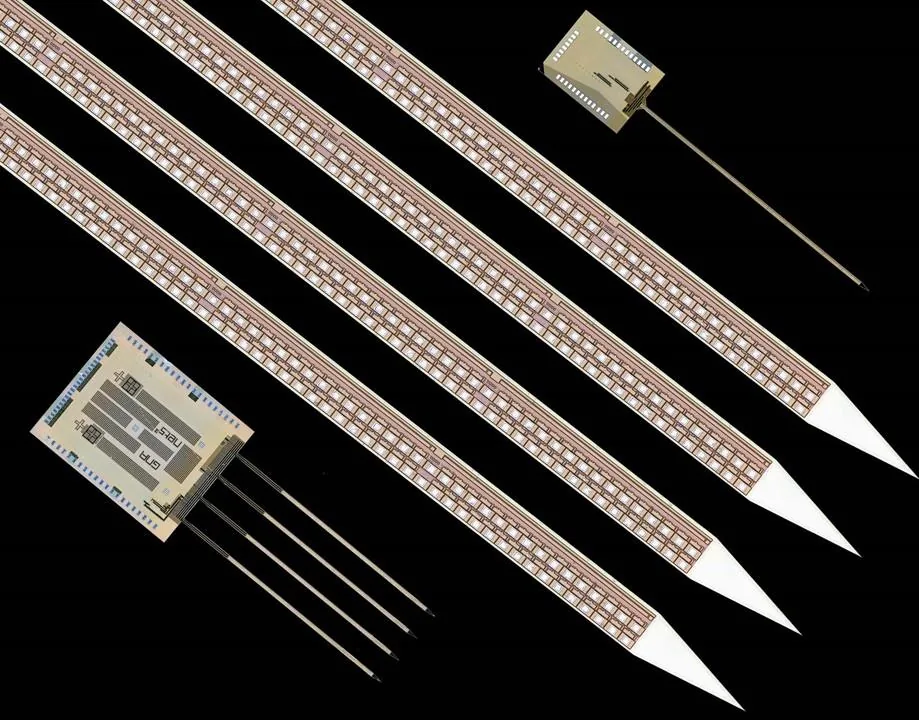
Figure 1. A SiNAPS probe: four shanks on the package board, and one shank with active-pixel sites along its length.
How does SiNAPS compare with Neuropixels?#
The two active probes differ most in how many of their sites they record at once.
| SiNAPS (HD Series) | Neuropixels 1.0 | Neuropixels 2.0 | Neuropixels 2.0 Quad Base | |
|---|---|---|---|---|
| Sites | 256 or 1,024 | 960 | 1,280 (one shank) or 5,120 (four) | 5,120 |
| Recorded at once | every site | 384 | 384 | 1,536 |
| Shanks | 1, 4 (560 µm apart) or 8 (300 µm) | 1 | 1 or 4 (250 µm apart) | 4 (250 µm apart) |
| Shank | 88 × 50 µm, 5 to 5.5 mm | 70 × 24 µm, 10 mm | 70 × 24 µm, 10 mm | 70 × 24 µm, 10 mm |
| Site | 14 × 14 µm platinum | 12 × 12 µm titanium nitride | 12 × 12 µm titanium nitride | 12 × 12 µm titanium nitride |
| Resolution | 12-bit | 10-bit | 12-bit | 12-bit |
| Sampling | 20 kS/s, one band | 30 kS/s spikes, 2.5 kS/s LFP | 30 kS/s, full band | 30 kS/s, full band |
| Noise, spike band | 6.5 µV rms | 5.9 µV rms | about 6.8 µV rms | about 7 µV rms |
| Headstage | none; digitized on the shank | one per probe | one per two probes | one per two probes |
| Stimulation | no | no | no | no |
SiNAPS leads where every site matters: the whole array is in every recording, with no bank of sites to choose and no unrecorded sites between sessions, and a 1,024-site SiNAPS records 2.7 times the simultaneous channels of a standard Neuropixels probe on up to eight shanks. Neuropixels leads on reach and on rate: a thinner, 10 mm shank, sampling at 30 kS/s, and 1,536 channels on the Quad Base. Noise is comparable across all four.
What does Neuropixels do better than SiNAPS?#
Three things, from the table. The shank is 70 × 24 µm and 10 mm long against 88 × 50 µm and 5 to 5.5 mm, so one Neuropixels penetration reaches deeper structures with less displaced tissue (Steinmetz et al. (2021) ↗). Sampling is 30 kS/s against 20 kS/s, which matters for waveform shape on fast-spiking units. And the Quad Base records 1,536 channels at once, half again a 1,024-site SiNAPS. Neuropixels is also the more widely used of the two, with open-source acquisition and sorting tools built around it. SiNAPS answers with every site recorded, eight shanks, and no headstage on the animal.
Neuropixels 1.0 or 2.0: what changes?#
Neuropixels 1.0 has 960 sites on one shank at a 20 µm row pitch and records 384 of them in two bands, spikes at 30 kS/s and local field potentials at 2.5 kS/s, at 10 bits (Jun et al. (2017) ↗). Neuropixels 2.0 puts 1,280 sites on a shank at 15 µm, offers four shanks 250 µm apart, records one full band at 12 bits, weighs about 0.17 g against 0.4 g, and fits two probes on one headstage (Steinmetz et al. (2021) ↗). Both are sold by imec today, 1.0 also in 45 mm versions for non-human primates. Against SiNAPS, the 2.0 matches its 12-bit resolution, and the 1.0 records LFP in a separate low-rate band.
What are the advantages of Neuropixels over a passive silicon probe?#
Channel count and digitization at the probe. A Neuropixels probe records 384 or 1,536 channels through one thin cable, where a passive probe records 4 to 256 and needs a trace and a headstage channel for each site. Dense site spacing along a 10 mm shank lets a spike sorter follow units as the brain moves relative to the probe. For large-scale recording of many units across several structures in one penetration, in a head-fixed or freely moving mouse, that is the strength. A 1,024-site SiNAPS shares it.
When is a passive silicon probe the better choice?#
When the experiment needs something an active probe does not do. Dense passive designs are functionally comparable to Neuropixels for some applications: Buzsáki and polytrode layouts place sites 20 to 25 µm apart, so each neuron appears on several sites and units separate in sorting (Buzsáki (2004) ↗). They also stimulate on the recording sites, with iridium and SIROF sites rated for charge injection (Cogan (2008) ↗); come on 15 µm silicon for a smaller chronic tissue response (Seymour & Kipke (2007) ↗); carry optical fibers as optrodes; come in 216 catalog designs and custom geometries; and connect through a probe package to the headstage of your choice. They stand on a published record that no other thin-film probe line approaches.
Can I stimulate while recording with Neuropixels?#
Not through the Neuropixels probe; it records only. Stimulation goes through a second probe that can deliver current, and the Commutator PRO carries both on one torque-compensated joint: up to four Neuropixels ports and a passive probe in record-and-stimulate mode, into XDAQ, so a freely moving animal is stimulated through the passive array while Neuropixels records. SiNAPS is also record-only; the passive designs are the probes that stimulate.
Which recording systems run Neuropixels?#
imec's own PXIe card and OneBox, with SpikeGLX or Open Ephys. XDAQ, engineered by Kontex and commercialized by NeuroNexus, runs Neuropixels in its NP mode with Kontex's acquisition software, which uses the Open Ephys plugin for the Neuropixels interface; the XDAQ ONE+ takes up to four probes. The Kontex NP Headstage connects the probe to XDAQ, directly or through the Commutator PRO. Radiens ↗ has a native Neuropixels probe model, and Videre's live recording monitor runs alongside the acquisition software and reads the recording as it is written, for signal quality during the session; it is in beta on Neuropixels rigs. The chain is set out in Recording Neuropixels on XDAQ.
Does NeuroNexus sell Neuropixels probes?#
No. Neuropixels probes are made and sold by imec, through neuropixels.org. NeuroNexus offers the equipment and software that make a Neuropixels experiment work, XDAQ, the Kontex NP Headstage, the Commutator PRO and Radiens, and two alternatives to the probe: SiNAPS, the other active-pixel probe, and the dense passive silicon probe designs.
Related documents#
- Recording Neuropixels on XDAQ: Headstage to Analysis
- SiNAPS: Active High-Density Microelectrodes
- High-Density Recording: A Planning Guide
- Neural Recording Chips: A Guide to DAQ ASICs
- Choosing an Electrode for Your Experiment
- NeuroNexus Probe Technology: Questions and Answers
Citations#
- Jun, J. J., et al. (2017). Fully integrated silicon probes for high-density recording of neural activity. Nature 551, 232–236. 10.1038/nature24636 ↗
- Steinmetz, N. A., et al. (2021). Neuropixels 2.0: A miniaturized high-density probe for stable, long-term brain recordings. Science 372, eabf4588. 10.1126/science.abf4588 ↗
- Angotzi, G. N., et al. (2019). SiNAPS: An implantable active pixel sensor CMOS-probe for simultaneous large-scale neural recordings. Biosensors and Bioelectronics 126, 355–364. 10.1016/j.bios.2018.10.032 ↗
- imec. Neuropixels 1.0, 2.0 and 2.0 Quad Base probe data sheets. neuropixels.org/support ↗
- Buzsáki, G. (2004). Large-scale recording of neuronal ensembles. Nature Neuroscience 7(5), 446–451. 10.1038/nn1233 ↗
- Seymour, J. P., and Kipke, D. R. (2007). Neural probe design for reduced tissue encapsulation in CNS. Biomaterials 28(25), 3594–3607. 10.1016/j.biomaterials.2007.03.024 ↗
- Cogan, S. F. (2008). Neural stimulation and recording electrodes. Annual Review of Biomedical Engineering 10, 275–309. 10.1146/annurev.bioeng.10.061807.160518 ↗