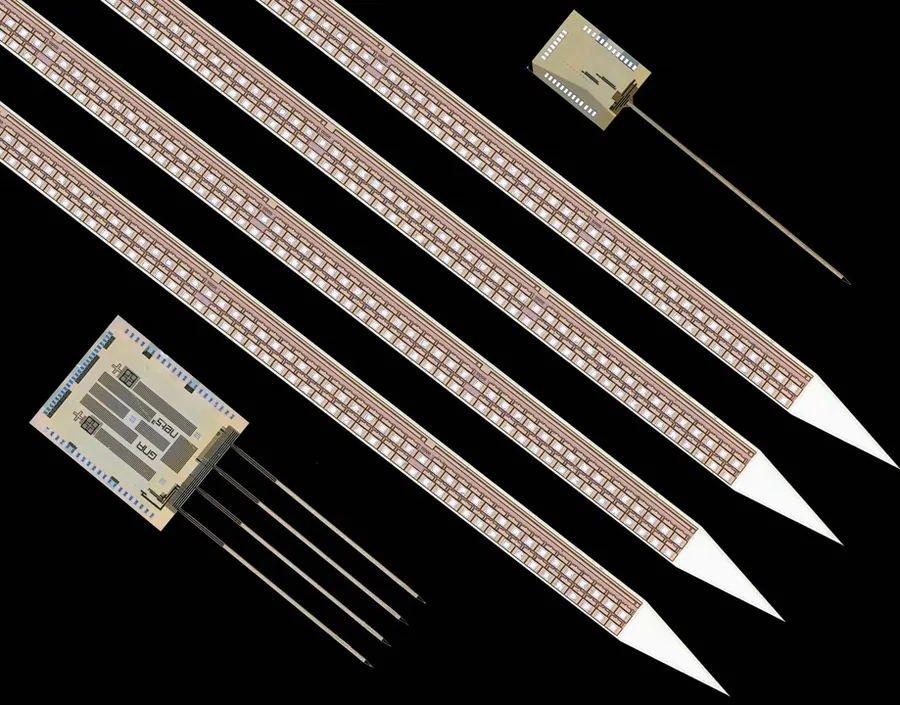
SiNAPS Recording System
A near-turnkey system for active-pixel recording at 256 or 1,024 sites.
The SiNAPS Recording System is a configured set for recording from a SiNAPS probe, a CMOS active-pixel silicon probe that records all of its sites simultaneously. NeuroNexus supplies the probe, the Smartbox Pro, the SiNAPS interface box and cables, and Radiens software with its license.
Choose one of three SiNAPS probe designs
NeuroNexus partners with Corticale to commercialize SiNAPS probes. The three designs have the same active-pixel sites and differ in layout. SiNAPS probes record only. An active-pixel array has no stimulation path.
One shank
The single-shank design records from one penetration.
Four shanks
The four-shank design has the longer active length on each shank, and it covers more depth.
Eight shanks
The eight-shank design has a shorter active length on each shank, and it covers more lateral extent.
SiNAPS Active-Pixel Probes
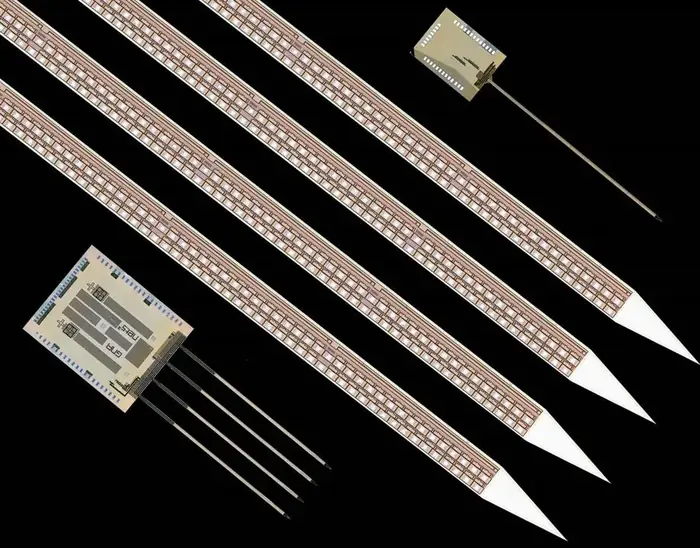
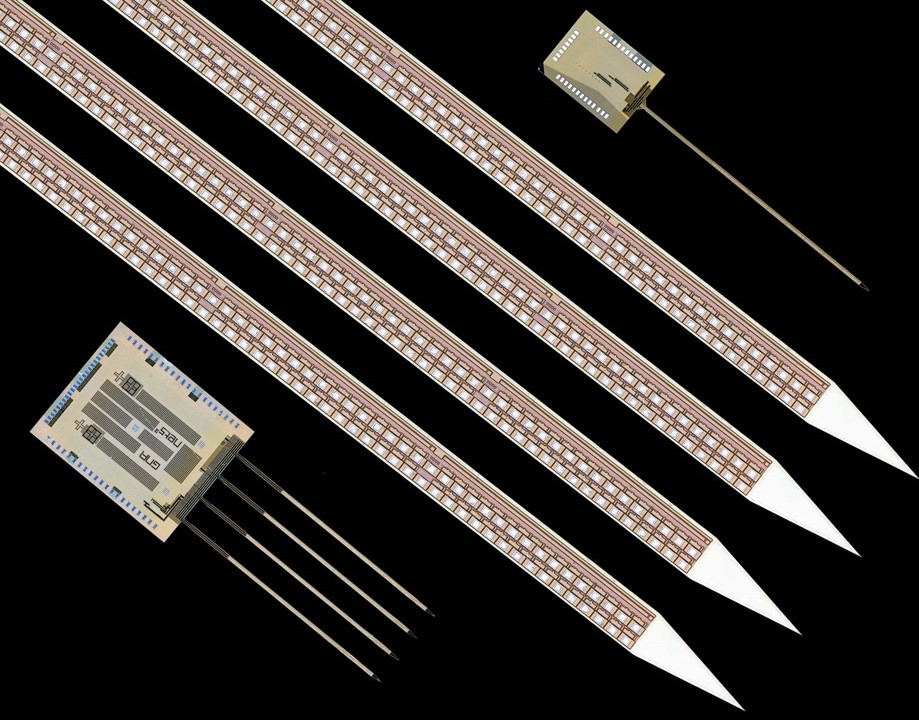
A SiNAPS probe is a CMOS active-pixel silicon probe with an amplifier beneath every electrode site, so it records neural activity from all of its sites simultaneously. The signals are digitized on the probe at 12 bits and a fixed 20 kS/s per site, so the recording chain has no headstage. This collection lists the three catalog designs of the High-Density Series: one shank with 256 sites, and four or eight shanks with 1,024 sites. The shanks are 5.0 to 5.5 mm long, with 14 × 14 µm platinum sites at a 30 µm pitch, and every site records the full band from 0.1 Hz to 5 kHz. The probes are acquired through the SiNAPS interface box by the SiNAPS configuration of Smartbox.
SiNAPS 1-Shank 256-Channel Probe
256-site active-pixel silicon probe
- Channels
- 256
- Shanks
- 1
- Shank length
- 5.5 mm
- Site layout
- Pixel
SiNAPS 4-Shank 1,024-Channel Probe
1,024-site active-pixel silicon probe, 4 shanks
- Channels
- 1024
- Shanks
- 4
- Shank length
- 5.5 mm
- Shank separation
- 560 µm
SiNAPS 8-Shank 1,024-Channel Probe
1,024-site active-pixel silicon probe, 8 shanks
- Channels
- 1024
- Shanks
- 8
- Shank length
- 5 mm
- Shank separation
- 300 µm
Set up the SiNAPS system and calibrate the probe
The system is supplied as a configured set, and each part is also available on its own. Setup follows the SiNAPS Manual, and the setup video shows the same steps.
What ships
The probe on its Activus SiNAPS package, the SiNAPS interface box and cables, the Smartbox Pro, and Radiens software with the license that SiNAPS acquisition requires.
The acquisition computer
The laboratory supplies it, to the requirements in the SiNAPS Manual. NeuroNexus can supply one on request.
Connect, install, calibrate
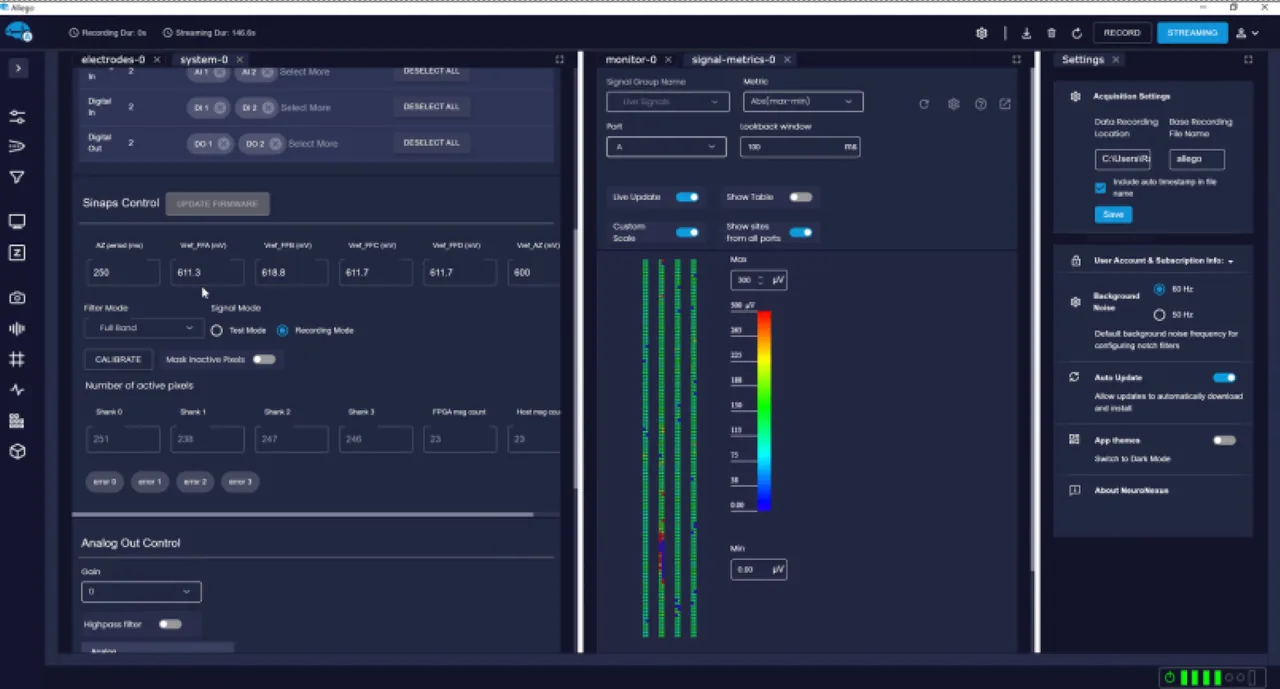
Connect the Smartbox Pro, the interface box and the probe. Install Allego and confirm that it reports the hardware. Calibrate the probe before each session.

Record from every SiNAPS site in Allego
Allego records every site of the probe. Every site records the full band from 0.1 Hz to 5 kHz at 20 kS/s, and no channels are selected before a recording. The signals are digitized on the probe, so the recording chain has no headstage.
The in vivo protocol
The SiNAPS Manual covers the craniotomy, the reference wire, insertion and calibration in tissue.
Calibrate again in tissue
After insertion, wait 15 to 20 minutes for the electrode surface to stabilize, and then run the calibration again.
Signal Metrics
Signal Metrics in Allego shows per-site metrics and a heat map of the probe during the session.
Analyze the SiNAPS recording in Radiens
Analysis continues in Radiens. The Radiens site describes its support for SiNAPS, which includes views on the probe layout and probe-specific spike sorting. A video shows SiNAPS sample data in Radiens.
Videre
Analysis runs in Videre, the Radiens application for analysis.
Probe maps
The SiNAPS Probe Maps give the site numbering for each design, so that a channel can be located on the probe.
Data volume
The high-density recording guide covers data volume and storage for a 1,024-site recording.
Published work with SiNAPS probes
Gonzalez et al. (2026), Nature 655, 192 recorded from the mouse hippocampus with a 1,024-channel SiNAPS probe, the Smartbox Pro, the SiNAPS interface box and Allego. Ransey et al. (2026), Nature 655, 703 recorded single units in the mouse medial prefrontal cortex and medial dorsal thalamus with the four-shank 1,024-channel design and the Smartbox Pro. Angotzi et al. (2026), IEEE Transactions on Biomedical Engineering recorded from the motor cortex of behaving macaques with 1,024-channel SiNAPS probes.The probe technology is described in Angotzi et al. (2019), Biosensors and Bioelectronics 126, 355–364 and Angotzi et al. (2025), Advanced Science 12, 2416239. Corticale describes the SiNAPS technology on its site and maintains the list of publications that used SiNAPS probes.
SiNAPS documents
Research use only. NeuroNexus products are for non-clinical research use and must not be used in human or veterinary medical procedures.
SiNAPS Recording System — FAQ
Is there an alternative to Neuropixels?
Yes, two. SiNAPS is the other active-pixel probe: its signals are digitized on the probe, and it records every one of its 256 or 1,024 sites at once, where Neuropixels records 384 chosen from 960 to 5,120 sites (1,536 on the Quad Base). Dense passive silicon probes, such as Buzsáki and polytrode layouts, are functionally comparable for some applications and stimulate on the recording sites.
How does SiNAPS compare with Neuropixels?
SiNAPS records every site at once, 1,024 on four or eight shanks, against 384 for Neuropixels 1.0 and 2.0 and 1,536 for the 2.0 Quad Base, which choose their channels from 960 to 5,120 sites. Both are 12-bit, except Neuropixels 1.0 at 10-bit, with comparable noise. Neuropixels has the thinner, 10 mm shank and samples at 30 kS/s against 20. Neither stimulates.