Grids · Cardiac Surface Grid Series
Epicardial 64-Channel Array
Polyimide that holds contact through a beating cycle — motion artifact, not amplitude, is the limit
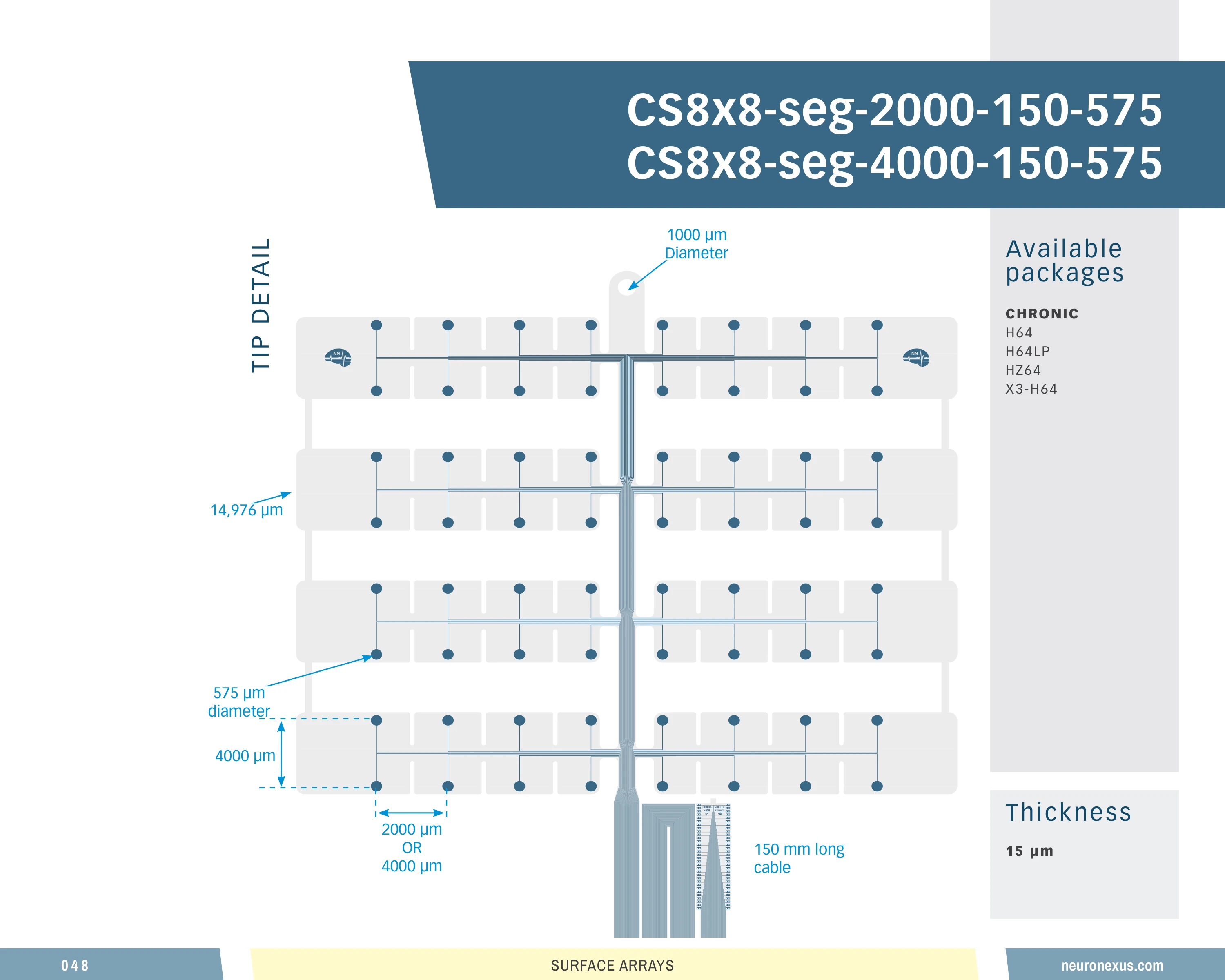
A thin polyimide film that lies on the epicardium and deforms with every beat, carrying large sites that average a broad patch at low impedance. Among the 56 grid designs in the design space it is in the upper quartile: 64 sites (a common choice — 9 of 55), a 15 mm site-array span (89th percentile), 0.3 sites/mm² (25th percentile) and a 114 mm³ neural interface (89th percentile).
Orders as a grid-plus-package assembly, in 5 package configurations, 3 of them microdrive-compatible. Polyimide 12 µm thick. Research use only.
SKU grd_ecg--cs8x8_seg_2000_cl150_575 · Grids in the webstore
Specifications
| Channels | 64 |
|---|---|
| Site layout | Grid |
| Site area | 259,672 µm² |
| Span | 14575 µm |
| Substrate | Polyimide |
| Site material | Platinum |
| Thickness | 12 µm |
| Neural interface volume | 113.628 mm³ (higher than 89% of 56 designs) |
| Site coverage density | 0.3 sites/mm² (higher than 25% of 56 designs) |
| Brain coverage density | 0.6 sites/mm³ (higher than 27% of 56 designs) |